From the very beginning of my time in the wine business at Gundlach Bundschu Winery, I insisted that we recognize and honor the people who did the actual work. Cellar rats and vineyard workers working side by side for a common goal allowed our winery to be successful. The work required long hours in difficult conditions and none of us got paid much, but it generated pride, joy, and a sense of a job well done.
Jim Bundschu and I believed were it not for the labor and contributions of Hispanic workers, there would be no California wine industry. As the second trio of our Vintage Reserve label series, we decided draw upon Hispanic images to produce the labels. Chuck House loved the idea, and in his inimitable way did a deep dive into Mexican art. Chuck was most impressed with Mexican muralists and created three stunning labels for us.
In his research, he happened across a magical place in the Mission District of San Francisco. It was called Balmy Alley, was a block long, and featured dozens of murals painted by local artists. Chuck took me to Balmy Alley. It was glorious and beautiful. He introduced me to Ray Patlan, a muralist who actually lived in an apartment in Balmy Alley, and was one of the alley’s most prolific artists,
I was so enamored by Balmy Alley and its murals that I proposed a field trip for the winery. Jim Bundschu was all for it. We rented a bus, loaded it with cellar rats, vineyard workers, even interested office staff and drove to Balmy Alley. Ray Patlan met us there with his primary painting colleague, Eduardo Pineda, and the two of them told us the history of Balmy Alley and then led us on a tour through the Mission District to see all the murals available. From there we all went to a local restaurant for dinner. Heading home, the bus had engine troubles. We pulled into a parking lot, discovered a bowling alley, and went bowling for an hour until the bus was running again to take us home.
The field trip was a smashing success. Our staff loved it, especially that everyone working at the winery was invited to attend. Bundschu and I came up with a great idea. We’d get Ray and Eduardo to paint a mural at Gundlach Bundschu. We pitched them on the idea, settled on a price, and set about creating a mural that would honor the Hispanic contribution to the California wine industry, acknowledge Gundlach Bundschu’s historic importance, and show what made our approach to winemaking special.
The Mural: Prep
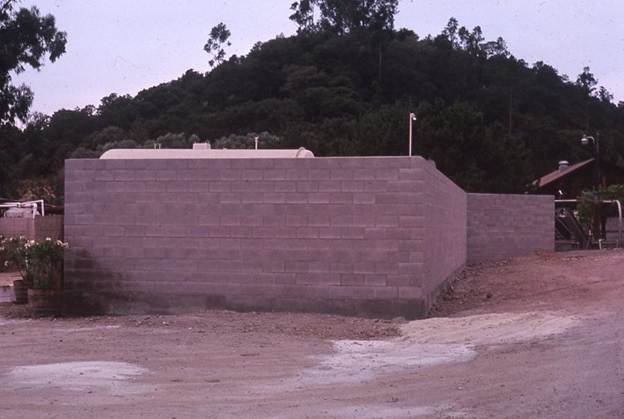
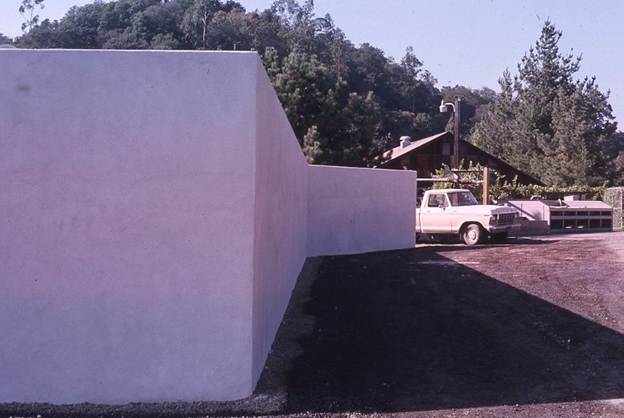
If you are going to do a mural, you need a canvas. We wanted the mural to be a major piece of art, so it had to be huge. Our idea was to build a wall around the tank farm of old dairy tanks that we used to make wine. Our wall would be eight feet high and 120 feet long. Ray and Eduardo were excited by our commitment.
At the time, my wife and I rented a small house on a two-acre parcel shared by our landlords, the Boninos. When I told Bob Bonino about our mural project, he introduced me to his previous tenant who worked as a mason. His name was Dave, and though he was semi-retired, he agreed to build our wall. It turned into a major endeavor, but Dave’s skill and expertise created the perfect canvas for our mural.
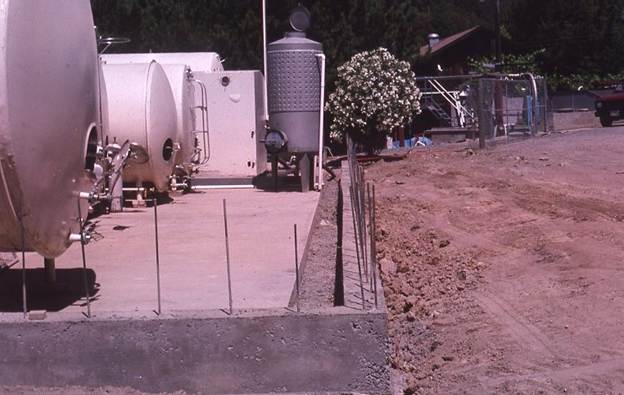
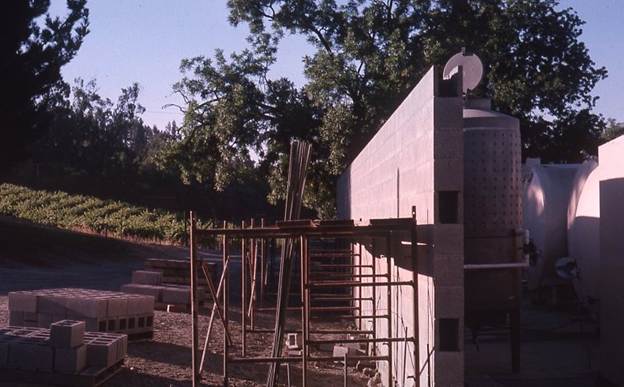
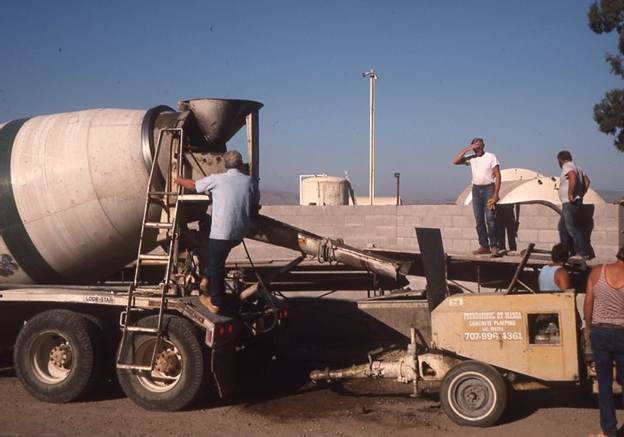
The first step was to dig trenches, use rebar and pour footings. Once the footings had cured, Dave slowly built the wall using concrete blocks and more rebar. At a certain height, he had to build a scaffold to continue. Dave built the entire wall by himself. He worked on it each day until he got tired, went home, and returned the next day until it was finished.
Dave was an incredible craftsman. His wall was straight, level and has already lasted almost 40 years. Once the concrete block wall was finished, cement trucks were brought in to fill up the holes in the concrete blocks. Dave is standing on the scaffold in a white T-shirt with one hand shading his eyes.
The wall was built. We whitewashed the entire thing with two coats of whitewash. It was ready for our artists.
Michael Coats was still working with his public relations company, Glodow, Coats and Nead, when they landed the Virgin Atlantic Airlines account. Richard Branson was launching the first direct flight from London to San Francisco, and they were responsible for the publicity.
Michael told me that there was already plenty of interest, particularly in the business arena, but they were looking for something that would carry over into a broader news spectrum, and they were hoping I could come up with something to help. They explained the details of the trip. Branson had filled that inaugural flight exclusively with reporters and travel writers from all over Europe. Once they arrived in San Francisco, Branson was hosting all the guests to five days in San Francisco, showing them all the Bay Area could offer. One day was scheduled as a Wine Country visit, to be hosted by Anthony Dias Blue. I looked at the schedule and saw that they were only visiting wineries in Napa.
“Well, hell, that’s not right,” I told Coats. “We’ll have to do something about that.”
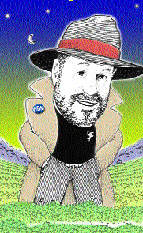
When the day approached, I got on board one of the two buses disguised as a local reporter, using my Jake Lorenzo alias. We visited several prestigious Napa wineries, had a posh lunch at a well-known restaurant, and ended the tour at Domaine Carneros with its pretentious French chateau sensibility inappropriately plopped on a hill in Carneros. After sipping sparkling wine and listening to an elaborate technical presentation from the winemaker, we all boarded the buses for the return trip to San Francisco.
With a collaborator, I boarded the lead bus, the one with Richard Branson, and looked carefully around the bus trying to locate bodyguards. Despite assurances from Coats, I couldn’t believe that Branson travelled without armed protectors. As the bus left Domaine Carneros, I reached into my bag and pulled out my mask and black velvet cape. I put them on while my partner passed up and down the aisle distributing a leaflet describing what we were about.
I stood in the aisle, right behind the driver and explained in my loudest voice that the passengers had been seduced by the pretension in Napa Valley, that the California wine business wasn’t really like that, and as a member of the Sonoma Valley Wine Patrol I was officially commandeering the bus to take them to Sonoma where they would participate in a cleansing ceremony that would wash away the pomposity of Napa Valley allowing them once again to enjoy the pleasures of fine wine.
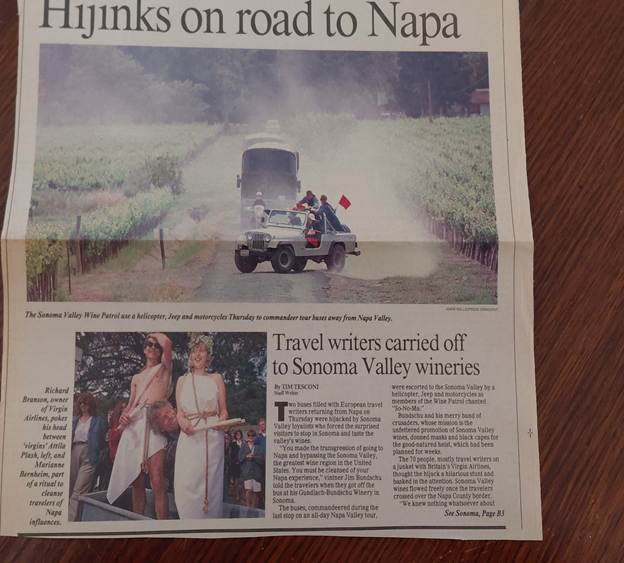
At that exact moment, just as we crossed over the Napa/Sonoma County line, a helicopter dropped down out of the sky to the eye level of the bus driver and proceeded to fly backward through the sky. The pilot and passenger, Jim McCullough, wore masks and black capes. Like something out of a war movie, we moved along the highway at 60 miles per hour staring into the cockpit of that helicopter as it flew backwards leading us into Sonoma.
Then as we came down the hill into Sonoma County, caped, masked cohorts on horseback, motorcycles and jeeps formed an escort and led the buses to Gundlach Bundschu winery. The mood in the bus went from nervous terror to shouted delight and I started to relax once I realized I wasn’t going to be shot by some overzealous bodyguard. Only then did I realize that the wine patrollers teetering from their jeeps and galloping on their horses looked pretty drunk. Turns out the Bundschus had hosted lunch, and everyone had been drinking for hours.
We turned onto the Gundlach Bundschu winery property where the road through the vineyard was lined with hundreds of local people cheering and holding signs proclaiming, “Welcome to Sonoma.” We parked the buses on the plateau by the tank farm and had them exit the buses as the helicopter landed in front of them. Locals presented them with Sonoma Valley blue stemmed glassware filled with wine and we escorted our charges down to the front of the winery, where Jim Bundschu welcomed them and reiterated how their Napa experience would foul their appreciation of wine unless they went through a cleansing ceremony.
He led them through our barrel cave and out back. Stretched out before our guests was 100 acres of pristine vineyard, with nary a house in sight. It looked much like it must have appeared to our ancestors, more than 100 years earlier, when they planted Rhinefarm. We had an old claw-foot bathtub set up with a young man and young woman dressed in togas stomping on grapes. As the juice dripped out of the bathtub drain, we pretended to collect it in carafes, while dozens of other people with carafes worked among the crowd pouring delicious Gundlach Bundschu wine.
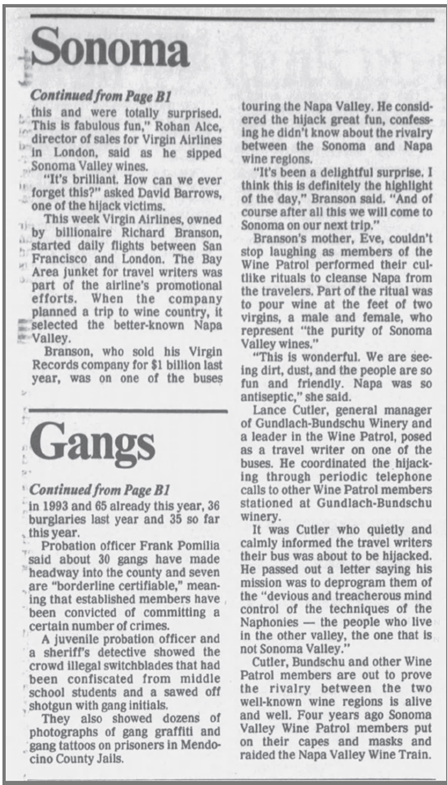
We made an announcement that by drinking this wine, they would rid themselves of the snobby pretentiousness of Napa winemaking and once again enjoy the pleasures of drinking fine wine. Everyone loved it. Richard Branson brought over a couple and introduced them to me as his parents. They hugged me and thanked me for a delightful afternoon.
As they finally returned to the buses for their trip back to San Francisco, we gave each passenger a blue-stemmed wine glass and put a case of wine on each bus for them to enjoy on the ride back. Coats was beside himself. “That could be the greatest thing I have ever seen,” he shouted. “They loved it. This will be in every newspaper and on every television newscast in Europe.”
Unfortunately, a few hours later it was announced that Jacquelyn Kennedy Onassis had died. Not a single word of the event reached Europe, or America for that matter. Luckily, even though we had kidnapped 70 European writers along with a billionaire, I also invited Tim Tesconi to the kidnapping. As far as I know, Tim’s story was the only one published about the event. but kidnapping Richard Branson remains one of the best organized, most exciting, entertaining stunts we ever pulled, made all the better because so few people found out about it, although to this day Richard Branson often tells people how much he enjoys Sonoma Wine Country.
Addendum
The verbatim copy of what we passed out on the bus during the kidnapping.
TAKE IT EASY.
DON’T GET QUESY.
Ladies and Gentlemen:
Welcome to Sonoma Valley. Please do not be alarmed. We are members of the Sonoma Valley Wine Patrol. The Wine Patrol is a non-violent, paramilitary organization empowered to take immediate action as deemed necessary in the event of any wine crime.
Unwittingly, you have been exposed to the devious and treacherous mind control techniques of the dreaded Naphonies. Naphonies are people who live in the other valley, the one that is not Sonoma Valley. Naphonies are identified by the expensive cars they drive and their punctilious, pompous attitudes about wine. They seduce people into thinking they are simple farmers, as they show you through their multi-million dollar palaces filled with high art. They act charming and dignified and never blink when they tell you that a bottle of their wine sells for upwards of $40. Their goal is to take over your thought process until the wines you drink offer no joy, pleasure, or magic.
Not to worry. The Sonoma Valley Wine Patro is here to rescue you from the evil Naphonies. We have commandeered your bus and are headed to a sacred Sonoma Valley location featuring one of the oldest vineyards in California. Once we arrive, we will put you through a simple, formal ceremony to free you of the evil mind control of the Naphonies. You will then be able to proceed on your journey, and you will once again be able to savor the joy and magic found in a great bottle of wine.
I repeat, you are in no danger. Please sit back and enjoy the ride. We in the Sonoma Valley Wine patrol are at your service.
In 1958, he and his family’s Golden Grain Co. invented Rice-a-Roni “The San Francisco Treat.” Rice-a-Roni was a tremendous success. DeDomenico bought the Ghirardelli Chocolate Company in 1964, and it also became a remarkably successful, iconic San Francisco product. He sold his Golden Grain Co along with Ghirardelli Chocolate to Quaker Oats for $250 million in 1986.
The next year, driven by his love of trains and looking for a business opportunity, he paid $2.5 million dollars to Southern Pacific Railroad for 21 miles of neglected tracks running through the center of Napa Valley parallel to Highway 29. Built during the Gold Rush, the train tracks brought San Franciscans up to resorts in Calistoga, but had not hauled passengers since 1929, and were at the time only used for occasional freight runs.
DeDomenico and his wife Mildred envisioned a luxury railroad that would carry passengers through Napa Valley. Called the Napa Valley Wine Train, the DeDomenicos planned to serve gourmet food and superlative wines in opulent vintage railcars. They purchased 20 Pullman cars from train museums in the Southeast for $2,500 apiece. They retrofitted each car with rich upholstered chairs, floral carpets, velvet curtains, mahogany trim, and brass luggage racks. Bathrooms had marble sink counters. Tables were set with fine linens, real China, and crystal glassware. The cost to retrofit each car approached $200,000.
It was a good plan, but the DeDomenicos had not accurately assessed the local response to a luxury train chugging up and down their valley. In September 1989 on opening day, protesters lined the tracks carrying signs opposing the Wine Train. The community had assailed the California Public Utilities Commission and got them to block the Wine Train from making any stops anywhere along the tracks.
Wineries were not fans of the Wine Train, probably because they were stunned to find that due to long forgotten right of ways acquired by Southern Pacific, the wineries were legally bound to pay for the track improvements that DeDomenico employed for his Wine Train. Imagine Robert Mondavi when presented with a bill for thousands of dollars to improve train tracks in front of his winery.
Locals complained of smoke from the engines, the noise of steel wheels on the tracks, and the dangers to traffic at railroad crossings. Norm Manzer, a Napa Valley insurance agent, started a group called Friends of the Napa Valley to lead opposition to the train. “The Wine Train is not a transportation or commuter operation,” Manzer stated. “It is nothing more than a bar and restaurant on wheels, plowing its way through the agricultural preserve of the Napa Valley.”
In 1989, this was a big deal. Every time we visited friends in Napa Valley, all they could talk about was the Wine Train. They complained about how it backed up traffic. They grumbled about how some rich guy was ruining their simple agrarian towns. They moaned about how it was changing their lives, but all they did was complain, go to meetings, and talk to one another.
Ray Kaufman and I had been political activists in Los Angeles. We met at Valley State College in 1966 and have been friends ever since. At that time Valley State was the Berkeley of Southern California. The Vietnam war protests were strong. The first Black Studies and Chicano Studies programs in the country were developed at Valley State. We started one of the country’s first Experimental Colleges, operated by and run for students. We had organized demonstrations and protests, and we were well acquainted with the bail and court systems involved when police confrontations occurred.
We thought that if Napa residents were serious about opposing the Wine Train, then they should get militant about it. Standing along the tracks holding up signs just wouldn’t cut it. Our Napa friends assumed we were joking and ignored our suggestion, but the idea had sprouted in our brains, and it slowly germinated until the Wine Patrol had a target.
I talked to McCullough and Bundschu about pulling off some action involving the Wine Train. They bought two tickets and went on a reconnaissance mission: reporting back about the posh service, the elegant decor, and the exclusive serving of Napa Valley wines. They felt a pretentious, haughty attitude pervaded the enterprise. We decided that we had nothing against the Napa Wine Train itself. After all, we were from Sonoma and the train wasn’t running up and down our valley, but Sonoma Valley was an up and coming wine region, one decidedly under Napa’s shadow. True or not, we felt Napa condescended to our efforts. The Wine Train offered an opportunity to present Sonoma wines to that Napa crowd and call them out for their pompous attitude.
We pitched our idea to other Sonoma Valley wineries we felt would be sympathetic to our plan. Initially, everyone was in favor of an action, but one by one they thought better of it. They feared bad publicity. They worried about inciting the ire of Napa wineries. By the time of our event, only Mike Berthoud, who worked at Arrowood Winery, joined our motley crew. Even Ray Kaufman’s winery wouldn’t let him participate.
We devised a plan that turned into the first Wine Patrol raid. We would purchase tickets for the Wine Train. Get onboard with loads of Sonoma Valley wine and pass it out free to the passengers. We’d pass out a leaflet praising the Sonoma Valley wines as wine of the people and contrasting them to the grandiose Napa estates. McCullough insisted that the leaflet be headed with our Wine Patrol logo, and since it was depicted in the logo, we all needed to be wearing capes.
Kristen Anacker was one of the models for our Merlot poster. Her dream, which she eventually fulfilled, was to be a costume designer in Hollywood. I asked her if she could make a dozen capes for our upcoming escapade. The day before our raid, Kristen showed up at the winery with gorgeous black velvet capes, each lined with different shades of brightly colored satin.
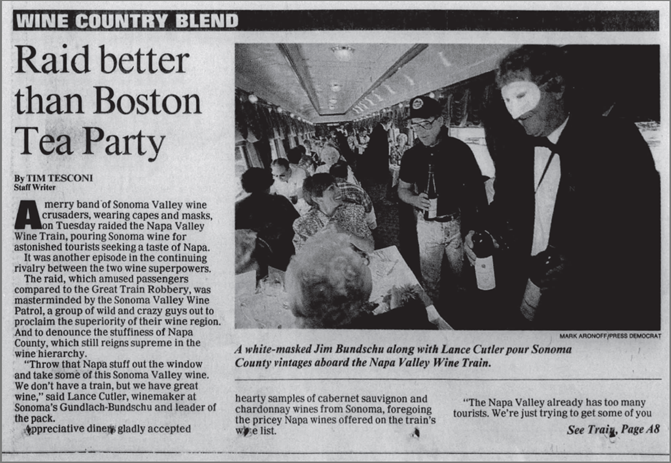
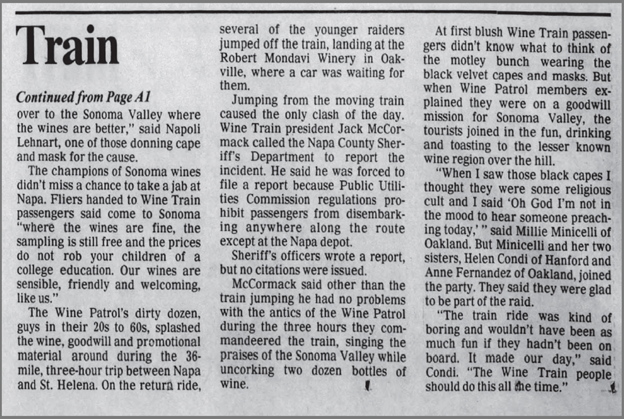
I believe the date was May 15, 1990, when a dozen of us showed up at the Wine Train Depot. We had invited Tim Tesconi, the Agricultural reporter for the Santa Rosa Press Democrat to document the escapade, and he joined us. We handed the porters our tickets and boarded the train. Each of us carried a canvas bag that held six bottles of Gundlach Bundschu wine. Once the train got rolling, we put on our masks and capes. Armed with corkscrews we wandered up and down the aisles of the train cars. We admonished passengers to “Throw that Napa swill out the windows and try some delicious wine from Sonoma. We don’t have a train, but we have great wine.”
As we poured free wine for the passengers, we passed out leaflets that read in part, “Come to Sonoma, where the wines are fine, the sampling is free, and the prices do not rob your children of a college education. Our wines are sensible, friendly, and welcoming; like us” We poured wine and entertained the passengers for the entire three hour ride to St. Helena and back. On the return trip, when the train slowed to a snail’s pace as it crossed the Robert Mondavi property, half of us leapt from the moving train where we had a driver and van waiting to spirit us away. Safely exiting that moving train may have been the most invigorating thing I’ve ever done.
Those of us in the van returned to the train depot to pick up the Wine Patrollers who remained on the train. As the train pulled into the station and we all joyously celebrated our successful raid, the Wine Train President, Jack McCormack, came over to tell us that disembarking a moving train was a federal offense. He said he was going into his office to call the Napa Valley Sheriff’s Department to report the incident as required by law.
Wine Patrollers are fun loving, but we are not dumb. Jack McCormack was doing us a solid, by warning us that he was calling the sheriffs. We made a hasty exit from the depot to our pre-arranged hideout: a restaurant just around the corner owned by a good friend, who previously owned a restaurant in Sonoma. As sheriff’s helicopters circled the sky looking for train hijackers, we comfortably sipped wine and ate tasty celebratory appetizers that our friend insisted on serving us. Once the coast was clear, we made our way back to Sonoma.
Tim Tesconi’s article came out in the Press Democrat the next day. He had done a terrific job emphasizing the whimsical nature of our raid. It was a fun thing for us and people in Sonoma found the whole story delightful.
A few days later, Herb Caen, the most popular columnist for the San Francisco Chronicle, wrote about Sonoma Valley winemakers donning capes and hijacking the Napa Wine Train. The story exploded. It was the equivalent to something going viral today. Radio, television, and newspapers called for details and the story raged for a weeks.
All the publicity instigated a visit from the Bureau of Alcohol, Tobacco and Firearms (BATF), the federal agency that dealt with liquor licenses. Two BATF agents interviewed Bundschu and me trying to get us to reveal the names of the other Wine Patrollers. We refused, even when they threatened to suspend our license to sell wine. They left and we had no idea whether they would pursue penalties. Thankfully, we never heard from them again.
The Napa Wine Train hijacking is one thing that everybody in the wine business still remembers. It was the opening salvo in the competitive battle between Sonoma and Napa. Even though most Napa wineries didn’t care less what these upstarts in Sonoma were doing, it resonated with reporters, wine salespeople, and consumers. Everyone loves an underdog. Like Magnificent Seven peasants, the Sonoma Valley Wine Patrol was standing up to the big guys, and we were starting to get attention.
In 1984, Jim Bundschu sent me to Los Angeles to see if I could jump start some wine sales. I worked with Jim McCullough who represented our wines through Seagram’s Chateau & Estate Wines Company. This was to be the last year we worked with Chateau and Estate, so we were also looking for someone to head up our sales program. We interviewed a few candidates, but no one really impressed us. After spending five days with Jim McCullough, I was sure he was the right fit for sales manager. He had experience, knowledge and passion for wine and he was a terrific salesman who knew how to work with distributors, set up programs, and locate key accounts.
The last event of the week was a wine tasting in Orange County where the two of us manned a table pouring Gundlach Bundschu wine. We were one of 20 wineries at the tasting. Just before the tasting, McCullough introduced me to Doug and Annie Diefenthaler. Jim knew the Diefenthalers from his days selling wine in Colorado. In fact, Doug took over Jim’s mountain territory when Jim moved on to become sales manager for Familia Torres Winery in the United States.
After the tasting, Jim, Doug, and Annie headed to Palm Springs to spend the weekend together. I returned to Sonoma and spent time in discussions with Jim Bundschu about how we’d move forward once we left Chateau & Estate. Eventually, based on my recommendation, Bundschu interviewed McCullough and offered him the position as Sales Manager for Gundlach Bundschu. After the interview, McCullough came over to my house for dinner. All he could talk about was this “Wine Patrol” concept he, Doug and Annie had come up with that weekend in Palm Springs.
They had spent that entire Palm Springs weekend drinking wine and tequila and talking about the state of the wine industry. Their inebriated discussions focused on the good guys: the dozens of small wineries run by dedicated people who were passionate about wine. Then there were the bad guys: large distribution companies and corporate wineries who controlled how wine was sold and focused on profits. The good guys, were like the peasants in the Magnificent Seven being held down and at the mercy of the big interests. They needed some tough High Plains Drifter types (Wine Rangers) to teach them how to stand up against the big interests who kept them stuck at the bottom of the totem pole. If those Wine Rangers could educate and train the dedicated but clueless winemakers in the ways of sales, they might have a fighting chance against the bad guys.
Those Wine Rangers would be called the Wine Patrol. The premise was that we could establish small outposts of trained patrollers who would go to war with the big distributors. They would serve as examples to others. This was the intellectual birth of the Wine Patrol. The concept of a Wine Patrol remained simple musings of friends sitting around drinking wine and talking about the industry until a series of disconnected events brought the concept into full bloom.
By 1996, Gundlach Bundschu had seen substantial increases in wine sales, and we were convinced that humor in our marketing would be successful and make us stand out. Jim McCullough and I decided to put together a seminar to teach small wineries how to deal with distributors, make calls on customers, and successfully sell their wines in various markets. We created a business entity to set up this training program. We registered our company as the Sonoma Valley Wine Patrol. I hired Chuck House to design a logo.
We put out notices and two dozen winemakers and winery owners signed up for that first seminar. Doug Diefentaler attended as a lecturer. McCullough explained how to set up programs with distributors. I focused on how winemakers could effectively use their time when working markets. We had them participate in role plays, changing buyer and seller roles. Unanimously, the participants loved the seminar saying it gave them ammunition to fight the good fight and sell their wares.
We told them they were the first rangers of the Wine Patrol. They needed to take what they had learned and successfully penetrate markets across the country. They needed to enlist like-minded people into the Wine Patrol. There was no set criteria for who these Wine Patrollers would be, but we assured them that they’d know one when they saw one.
Jake Lorenzo is pretty sure that my ongoing love affair with wine is likely Pavlovian in nature. Ivan Pavlov was a Russian physiologist in the early 1900s who observed a type of learning where an animal (or human) learned to associate unrelated things to each other. Pavlov famously demonstrated that his dogs began to salivate at the sound of a bell linked to feeding time. Pavlov’s experiments with dogs led to a groundbreaking discovery in psychology known as classical conditioning. Classical conditioning explains how behaviors can be learned through association.
We don’t ring a bell at Jake Lorenzo’s house, nor do we own a dog, but the pop of a cork designates that work is over, a meal is on the way, and we are soon to be involved in some sort of pleasant social interaction. A bottle of wine on the table gives this detective confidence that the food will be delicious, the conversation entertaining, and that people are less likely to be checking their phones. Jake Lorenzo has this reaction to wine because I have been experiencing it for decades, without fail every time I hear that cork pop. Hell, I’m even picking it up when I hear someone twist a screw cap.
Not only that, but a wine bottle sitting on a table can make friends. Many years ago, this detective found himself in a dive Mexican restaurant that specialized in offal tacos. I sat down and gave my order to the waitress when I noticed the guy at the table next to me sipping from a bottle of Chalone Pinot Noir. “Good choice,” I said, “How’s it go with the tacos?”
“Grab a glass and I’ll let you find out,” the gentleman responded. That was my first meeting with Chuy Palacios. Over tacos de lengua, labios, and sesos, we shared a stunning bottle of wine and began a friendship that has lasted more than 50 years.
Classical conditioning is an automatic, learned response to something that normally wouldn’t trigger that response. You hear a notification sound on your phone and immediately feel a rush of anticipation, even before you see the message. That’s a Pavlovian response. The term has become shorthand for any situation where we’ve been trained, often without realizing it, to react a certain way.
Pavlov would be ringing bells in his grave to no avail if he knew what his discovery has been turned into. Most classical conditioning is now very sophisticated and focused on getting you to purchase things. Click on an advertisement for any item and you will be inundated with dozens of prompts from vendors selling related items. Shopping for a bottle of wine online is like unleashing a direct line for wine shops to bombard you with offers about anything in a bottle.
Rooted in the principle of classical conditioning, another kind of response is aversion conditioning, which has sprouted a whole technique known as aversion therapy. Instead of experiencing pleasure from an unrecognized action, the brain forms a negative association with a stimulus. A behavior that was previously rewarding turns negative and painful. That discomfort causes you to stop doing what used to give you pleasure and try something else.
As far as Jake Lorenzo is concerned, restaurant wine pricing has turned into aversion therapy. This detective used to love going to a restaurant, perusing the wine list, and finding some treasure that fit my budget, but restaurants have stolen that pleasure from me. Looking at wine list prices has become so painful that now I just bring a bottle of wine, pay the corkage, and don’t even glance at the list.
Back in the day when Jake Lorenzo got into the wine business, it was a joyful, passionate ride. Just a handful of wineries and a small cadre of cellar rats working our butts off making wine. We didn’t know what we were doing, but we learned. We saw our wines improve year after year, and that gave us confidence. We took pride in working hard to produce a product that people enjoyed and made part of their lives. It was classical conditioning reaffirming our life’s choices in the best of ways.
We didn’t just make wine; we made wine a major part of our lives. We discovered that sparkling wine poured for guests when they entered our home, signaled the start of a great evening. Dry gewürztraminer perfectly set off any seafood starter. Pinot noir with an entrée enhanced every meal. Cabernet sauvignon went so well with aged cheeses. Wine makes food taste better and food brings out the best qualities in fine wine. It is one of life’s ultimate symbiotic relationships. It’s as if Pavlov was a chef and his cooking changed our behavior at the dinner table.
It saddens this detective that a whole generation of young people have seemingly renounced the pleasures afforded them by wine. They have no idea what they are missing. The recent literature on wine and health keeps changing, but this detective is positive that wine is an effective social lubricant, one that reduces stress, and increases inquisitiveness.
For Jakelyn’s mother and me, wine has played a significant role in our lives. We have found every aspect of wine inspiring; from the dedication and perseverance of grape farmers to the commitment and playfulness of cellar rats, to the precision and talent of barrel makers and even the enthusiastic ramblings of wine salespeople. Our travels often focus on wine. We have enjoyed wine with our meals in dozens of countries around the world. Together, wine and food give an insight into a people, their culture and history that we might not get otherwise.
We were introduced to most of our friends at a table with bottles of wine and tasty food present. Chuy Palacios went from a stranger in a taco joint drinking Chalone Pinot Noir to my best friend. I respect Dr. Iggy Calamari, not just because he is a world class scientist, but as the man who actually uses wine to save people’s lives with his wine powered pacemaker. The hundreds of friends, guests and tourists who have shown up on our porch or at our table for a meal have always enjoyed the wine served with the food almost as much as Jakelyn’s mother and I took pleasure in hosting them.
Ivan Pavlov would love a three-hour lunch on Jake Lorenzo’s porch. There would be no bells, but the popping of wine corks should start him salivating. Classical conditioning at its finest, and it would make for a memorable afternoon.