Vincent DeDomenico loved trains.
In 1958, he and his family’s Golden Grain Co. invented Rice-a-Roni “The San Francisco Treat.” Rice-a-Roni was a tremendous success. DeDomenico bought the Ghirardelli Chocolate Company in 1964, and it also became a remarkably successful, iconic San Francisco product. He sold his Golden Grain Co along with Ghirardelli Chocolate to Quaker Oats for $250 million in 1986.
The next year, driven by his love of trains and looking for a business opportunity, he paid $2.5 million dollars to Southern Pacific Railroad for 21 miles of neglected tracks running through the center of Napa Valley parallel to Highway 29. Built during the Gold Rush, the train tracks brought San Franciscans up to resorts in Calistoga, but had not hauled passengers since 1929, and were at the time only used for occasional freight runs.
DeDomenico and his wife Mildred envisioned a luxury railroad that would carry passengers through Napa Valley. Called the Napa Valley Wine Train, the DeDomenicos planned to serve gourmet food and superlative wines in opulent vintage railcars. They purchased 20 Pullman cars from train museums in the Southeast for $2,500 apiece. They retrofitted each car with rich upholstered chairs, floral carpets, velvet curtains, mahogany trim, and brass luggage racks. Bathrooms had marble sink counters. Tables were set with fine linens, real China, and crystal glassware. The cost to retrofit each car approached $200,000.
It was a good plan, but the DeDomenicos had not accurately assessed the local response to a luxury train chugging up and down their valley. In September 1989 on opening day, protesters lined the tracks carrying signs opposing the Wine Train. The community had assailed the California Public Utilities Commission and got them to block the Wine Train from making any stops anywhere along the tracks.
Wineries were not fans of the Wine Train, probably because they were stunned to find that due to long forgotten right of ways acquired by Southern Pacific, the wineries were legally bound to pay for the track improvements that DeDomenico employed for his Wine Train. Imagine Robert Mondavi when presented with a bill for thousands of dollars to improve train tracks in front of his winery.
Locals complained of smoke from the engines, the noise of steel wheels on the tracks, and the dangers to traffic at railroad crossings. Norm Manzer, a Napa Valley insurance agent, started a group called Friends of the Napa Valley to lead opposition to the train. “The Wine Train is not a transportation or commuter operation,” Manzer stated. “It is nothing more than a bar and restaurant on wheels, plowing its way through the agricultural preserve of the Napa Valley.”
In 1989, this was a big deal. Every time we visited friends in Napa Valley, all they could talk about was the Wine Train. They complained about how it backed up traffic. They grumbled about how some rich guy was ruining their simple agrarian towns. They moaned about how it was changing their lives, but all they did was complain, go to meetings, and talk to one another.
Ray Kaufman and I had been political activists in Los Angeles. We met at Valley State College in 1966 and have been friends ever since. At that time Valley State was the Berkeley of Southern California. The Vietnam war protests were strong. The first Black Studies and Chicano Studies programs in the country were developed at Valley State. We started one of the country’s first Experimental Colleges, operated by and run for students. We had organized demonstrations and protests, and we were well acquainted with the bail and court systems involved when police confrontations occurred.
We thought that if Napa residents were serious about opposing the Wine Train, then they should get militant about it. Standing along the tracks holding up signs just wouldn’t cut it. Our Napa friends assumed we were joking and ignored our suggestion, but the idea had sprouted in our brains, and it slowly germinated until the Wine Patrol had a target.
I talked to McCullough and Bundschu about pulling off some action involving the Wine Train. They bought two tickets and went on a reconnaissance mission: reporting back about the posh service, the elegant decor, and the exclusive serving of Napa Valley wines. They felt a pretentious, haughty attitude pervaded the enterprise. We decided that we had nothing against the Napa Wine Train itself. After all, we were from Sonoma and the train wasn’t running up and down our valley, but Sonoma Valley was an up and coming wine region, one decidedly under Napa’s shadow. True or not, we felt Napa condescended to our efforts. The Wine Train offered an opportunity to present Sonoma wines to that Napa crowd and call them out for their pompous attitude.
We pitched our idea to other Sonoma Valley wineries we felt would be sympathetic to our plan. Initially, everyone was in favor of an action, but one by one they thought better of it. They feared bad publicity. They worried about inciting the ire of Napa wineries. By the time of our event, only Mike Berthoud, who worked at Arrowood Winery, joined our motley crew. Even Ray Kaufman’s winery wouldn’t let him participate.
We devised a plan that turned into the first Wine Patrol raid. We would purchase tickets for the Wine Train. Get onboard with loads of Sonoma Valley wine and pass it out free to the passengers. We’d pass out a leaflet praising the Sonoma Valley wines as wine of the people and contrasting them to the grandiose Napa estates. McCullough insisted that the leaflet be headed with our Wine Patrol logo, and since it was depicted in the logo, we all needed to be wearing capes.
Kristen Anacker was one of the models for our Merlot poster. Her dream, which she eventually fulfilled, was to be a costume designer in Hollywood. I asked her if she could make a dozen capes for our upcoming escapade. The day before our raid, Kristen showed up at the winery with gorgeous black velvet capes, each lined with different shades of brightly colored satin.
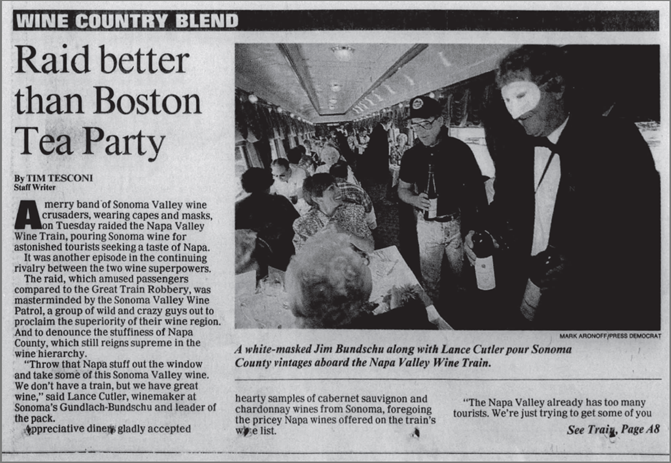
I believe the date was May 15, 1990, when a dozen of us showed up at the Wine Train Depot. We had invited Tim Tesconi, the Agricultural reporter for the Santa Rosa Press Democrat to document the escapade, and he joined us. We handed the porters our tickets and boarded the train. Each of us carried a canvas bag that held six bottles of Gundlach Bundschu wine. Once the train got rolling, we put on our masks and capes. Armed with corkscrews we wandered up and down the aisles of the train cars. We admonished passengers to “Throw that Napa swill out the windows and try some delicious wine from Sonoma. We don’t have a train, but we have great wine.”
As we poured free wine for the passengers, we passed out leaflets that read in part, “Come to Sonoma, where the wines are fine, the sampling is free, and the prices do not rob your children of a college education. Our wines are sensible, friendly, and welcoming; like us” We poured wine and entertained the passengers for the entire three hour ride to St. Helena and back. On the return trip, when the train slowed to a snail’s pace as it crossed the Robert Mondavi property, half of us leapt from the moving train where we had a driver and van waiting to spirit us away. Safely exiting that moving train may have been the most invigorating thing I’ve ever done.
Those of us in the van returned to the train depot to pick up the Wine Patrollers who remained on the train. As the train pulled into the station and we all joyously celebrated our successful raid, the Wine Train President, Jack McCormack, came over to tell us that disembarking a moving train was a federal offense. He said he was going into his office to call the Napa Valley Sheriff’s Department to report the incident as required by law.
Wine Patrollers are fun loving, but we are not dumb. Jack McCormack was doing us a solid, by warning us that he was calling the sheriffs. We made a hasty exit from the depot to our pre-arranged hideout: a restaurant just around the corner owned by a good friend, who previously owned a restaurant in Sonoma. As sheriff’s helicopters circled the sky looking for train hijackers, we comfortably sipped wine and ate tasty celebratory appetizers that our friend insisted on serving us. Once the coast was clear, we made our way back to Sonoma.
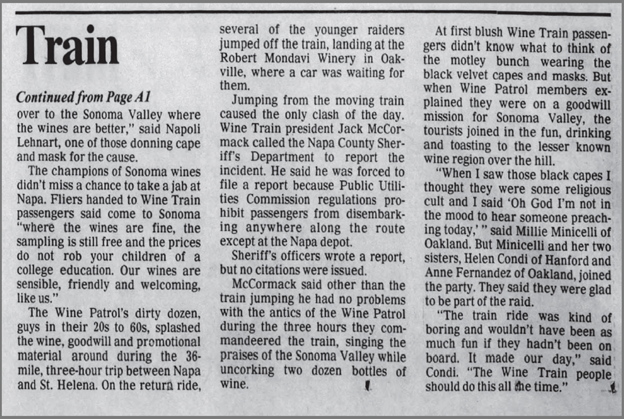
Tim Tesconi’s article came out in the Press Democrat the next day. He had done a terrific job emphasizing the whimsical nature of our raid. It was a fun thing for us and people in Sonoma found the whole story delightful.
A few days later, Herb Caen, the most popular columnist for the San Francisco Chronicle, wrote about Sonoma Valley winemakers donning capes and hijacking the Napa Wine Train. The story exploded. It was the equivalent to something going viral today. Radio, television, and newspapers called for details and the story raged for a weeks.
All the publicity instigated a visit from the Bureau of Alcohol, Tobacco and Firearms (BATF), the federal agency that dealt with liquor licenses. Two BATF agents interviewed Bundschu and me trying to get us to reveal the names of the other Wine Patrollers. We refused, even when they threatened to suspend our license to sell wine. They left and we had no idea whether they would pursue penalties. Thankfully, we never heard from them again.
The Napa Wine Train hijacking is one thing that everybody in the wine business still remembers. It was the opening salvo in the competitive battle between Sonoma and Napa. Even though most Napa wineries didn’t care less what these upstarts in Sonoma were doing, it resonated with reporters, wine salespeople, and consumers. Everyone loves an underdog. Like Magnificent Seven peasants, the Sonoma Valley Wine Patrol was standing up to the big guys, and we were starting to get attention.
