From the very beginning of my time in the wine business at Gundlach Bundschu Winery, I insisted that we recognize and honor the people who did the actual work. Cellar rats and vineyard workers working side by side for a common goal allowed our winery to be successful. The work required long hours in difficult conditions and none of us got paid much, but it generated pride, joy, and a sense of a job well done.
Jim Bundschu and I believed were it not for the labor and contributions of Hispanic workers, there would be no California wine industry. As the second trio of our Vintage Reserve label series, we decided draw upon Hispanic images to produce the labels. Chuck House loved the idea, and in his inimitable way did a deep dive into Mexican art. Chuck was most impressed with Mexican muralists and created three stunning labels for us.
In his research, he happened across a magical place in the Mission District of San Francisco. It was called Balmy Alley, was a block long, and featured dozens of murals painted by local artists. Chuck took me to Balmy Alley. It was glorious and beautiful. He introduced me to Ray Patlan, a muralist who actually lived in an apartment in Balmy Alley, and was one of the alley’s most prolific artists,
I was so enamored by Balmy Alley and its murals that I proposed a field trip for the winery. Jim Bundschu was all for it. We rented a bus, loaded it with cellar rats, vineyard workers, even interested office staff and drove to Balmy Alley. Ray Patlan met us there with his primary painting colleague, Eduardo Pineda, and the two of them told us the history of Balmy Alley and then led us on a tour through the Mission District to see all the murals available. From there we all went to a local restaurant for dinner. Heading home, the bus had engine troubles. We pulled into a parking lot, discovered a bowling alley, and went bowling for an hour until the bus was running again to take us home.
The field trip was a smashing success. Our staff loved it, especially that everyone working at the winery was invited to attend. Bundschu and I came up with a great idea. We’d get Ray and Eduardo to paint a mural at Gundlach Bundschu. We pitched them on the idea, settled on a price, and set about creating a mural that would honor the Hispanic contribution to the California wine industry, acknowledge Gundlach Bundschu’s historic importance, and show what made our approach to winemaking special.
The Mural: Prep
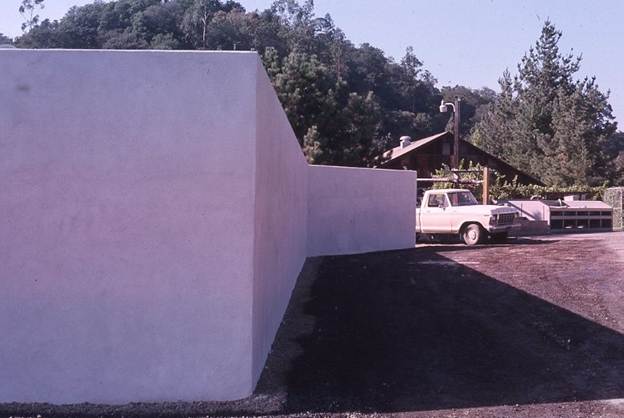
If you are going to do a mural, you need a canvas. We wanted the mural to be a major piece of art, so it had to be huge. Our idea was to build a wall around the tank farm of old dairy tanks that we used to make wine. Our wall would be eight feet high and 120 feet long. Ray and Eduardo were excited by our commitment.
At the time, my wife and I rented a small house on a two-acre parcel shared by our landlords, the Boninos. When I told Bob Bonino about our mural project, he introduced me to his previous tenant who worked as a mason. His name was Dave, and though he was semi-retired, he agreed to build our wall. It turned into a major endeavor, but Dave’s skill and expertise created the perfect canvas for our mural.
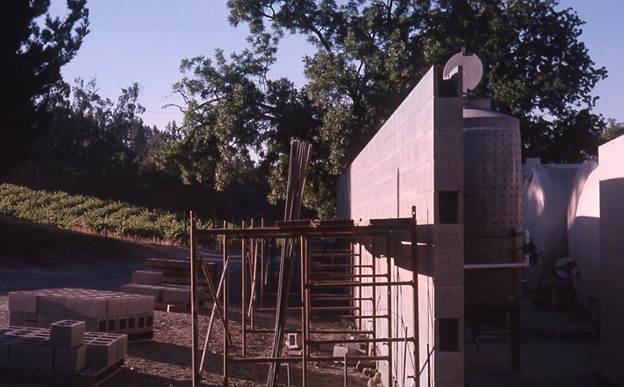
The first step was to dig trenches, use rebar and pour footings. Once the footings had cured, Dave slowly built the wall using concrete blocks and more rebar. At a certain height, he had to build a scaffold to continue. Dave built the entire wall by himself. He worked on it each day until he got tired, went home, and returned the next day until it was finished.
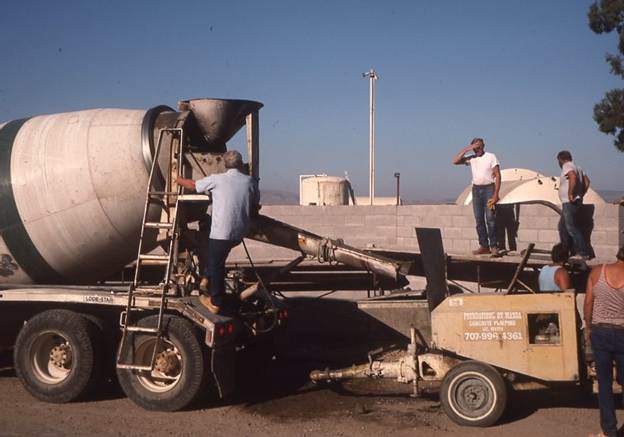
Dave was an incredible craftsman. His wall was straight, level and has already lasted almost 40 years. Once the concrete block wall was finished, cement trucks were brought in to fill up the holes in the concrete blocks. Dave is standing on the scaffold in a white T-shirt with one hand shading his eyes.
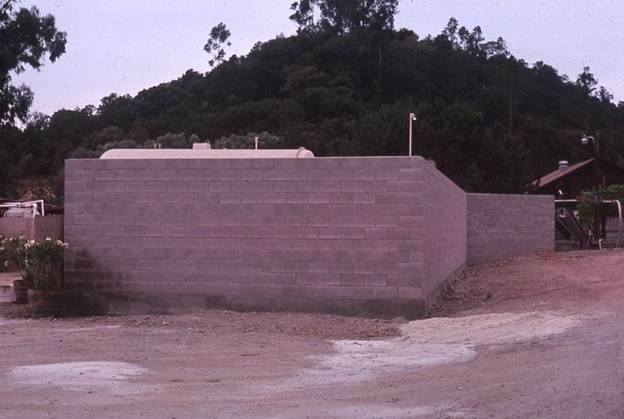
The wall was built. We whitewashed the entire thing with two coats of whitewash. It was ready for our artists.
Michael Coats was still working with his public relations company, Glodow, Coats and Nead, when they landed the Virgin Atlantic Airlines account. Richard Branson was launching the first direct flight from London to San Francisco, and they were responsible for the publicity.
Michael told me that there was already plenty of interest, particularly in the business arena, but they were looking for something that would carry over into a broader news spectrum, and they were hoping I could come up with something to help. They explained the details of the trip. Branson had filled that inaugural flight exclusively with reporters and travel writers from all over Europe. Once they arrived in San Francisco, Branson was hosting all the guests to five days in San Francisco, showing them all the Bay Area could offer. One day was scheduled as a Wine Country visit, to be hosted by Anthony Dias Blue. I looked at the schedule and saw that they were only visiting wineries in Napa.
“Well, hell, that’s not right,” I told Coats. “We’ll have to do something about that.”
When the day approached, I got on board one of the two buses disguised as a local reporter, using my Jake Lorenzo alias. We visited several prestigious Napa wineries, had a posh lunch at a well-known restaurant, and ended the tour at Domaine Carneros with its pretentious French chateau sensibility inappropriately plopped on a hill in Carneros. After sipping sparkling wine and listening to an elaborate technical presentation from the winemaker, we all boarded the buses for the return trip to San Francisco.
With a collaborator, I boarded the lead bus, the one with Richard Branson, and looked carefully around the bus trying to locate bodyguards. Despite assurances from Coats, I couldn’t believe that Branson travelled without armed protectors. As the bus left Domaine Carneros, I reached into my bag and pulled out my mask and black velvet cape. I put them on while my partner passed up and down the aisle distributing a leaflet describing what we were about.
I stood in the aisle, right behind the driver and explained in my loudest voice that the passengers had been seduced by the pretension in Napa Valley, that the California wine business wasn’t really like that, and as a member of the Sonoma Valley Wine Patrol I was officially commandeering the bus to take them to Sonoma where they would participate in a cleansing ceremony that would wash away the pomposity of Napa Valley allowing them once again to enjoy the pleasures of fine wine.
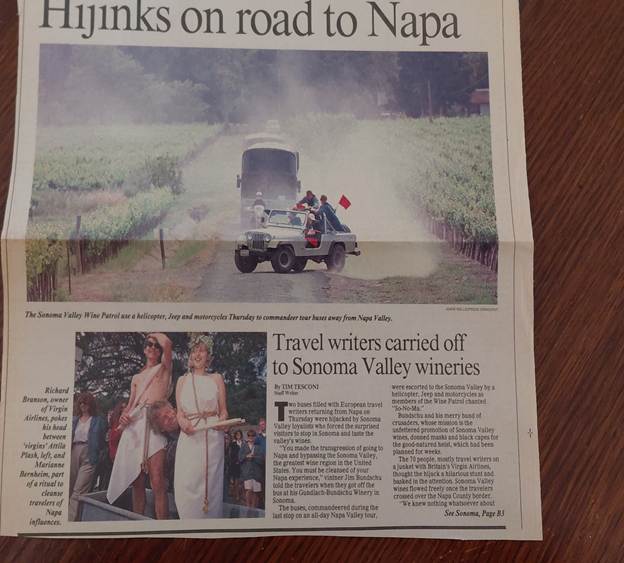
At that exact moment, just as we crossed over the Napa/Sonoma County line, a helicopter dropped down out of the sky to the eye level of the bus driver and proceeded to fly backward through the sky. The pilot and passenger, Jim McCullough, wore masks and black capes. Like something out of a war movie, we moved along the highway at 60 miles per hour staring into the cockpit of that helicopter as it flew backwards leading us into Sonoma.
Then as we came down the hill into Sonoma County, caped, masked cohorts on horseback, motorcycles and jeeps formed an escort and led the buses to Gundlach Bundschu winery. The mood in the bus went from nervous terror to shouted delight and I started to relax once I realized I wasn’t going to be shot by some overzealous bodyguard. Only then did I realize that the wine patrollers teetering from their jeeps and galloping on their horses looked pretty drunk. Turns out the Bundschus had hosted lunch, and everyone had been drinking for hours.
We turned onto the Gundlach Bundschu winery property where the road through the vineyard was lined with hundreds of local people cheering and holding signs proclaiming, “Welcome to Sonoma.” We parked the buses on the plateau by the tank farm and had them exit the buses as the helicopter landed in front of them. Locals presented them with Sonoma Valley blue stemmed glassware filled with wine and we escorted our charges down to the front of the winery, where Jim Bundschu welcomed them and reiterated how their Napa experience would foul their appreciation of wine unless they went through a cleansing ceremony.
He led them through our barrel cave and out back. Stretched out before our guests was 100 acres of pristine vineyard, with nary a house in sight. It looked much like it must have appeared to our ancestors, more than 100 years earlier, when they planted Rhinefarm. We had an old claw-foot bathtub set up with a young man and young woman dressed in togas stomping on grapes. As the juice dripped out of the bathtub drain, we pretended to collect it in carafes, while dozens of other people with carafes worked among the crowd pouring delicious Gundlach Bundschu wine.
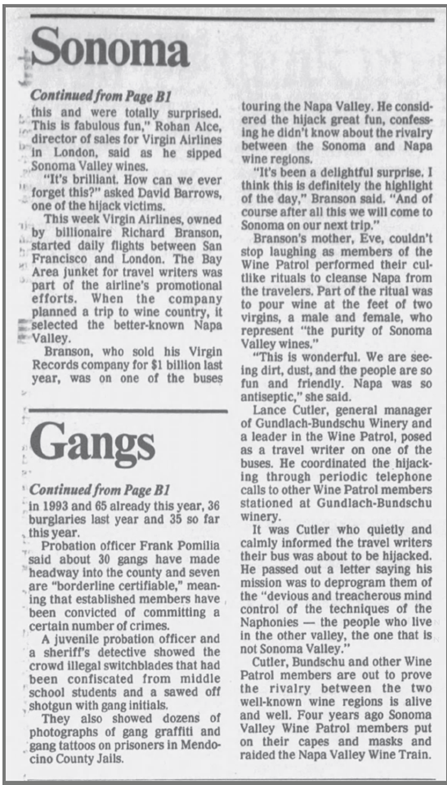
We made an announcement that by drinking this wine, they would rid themselves of the snobby pretentiousness of Napa winemaking and once again enjoy the pleasures of drinking fine wine. Everyone loved it. Richard Branson brought over a couple and introduced them to me as his parents. They hugged me and thanked me for a delightful afternoon.
As they finally returned to the buses for their trip back to San Francisco, we gave each passenger a blue-stemmed wine glass and put a case of wine on each bus for them to enjoy on the ride back. Coats was beside himself. “That could be the greatest thing I have ever seen,” he shouted. “They loved it. This will be in every newspaper and on every television newscast in Europe.”
Unfortunately, a few hours later it was announced that Jacquelyn Kennedy Onassis had died. Not a single word of the event reached Europe, or America for that matter. Luckily, even though we had kidnapped 70 European writers along with a billionaire, I also invited Tim Tesconi to the kidnapping. As far as I know, Tim’s story was the only one published about the event. but kidnapping Richard Branson remains one of the best organized, most exciting, entertaining stunts we ever pulled, made all the better because so few people found out about it, although to this day Richard Branson often tells people how much he enjoys Sonoma Wine Country.
Addendum
The verbatim copy of what we passed out on the bus during the kidnapping.
TAKE IT EASY.
DON’T GET QUESY.
Ladies and Gentlemen:
Welcome to Sonoma Valley. Please do not be alarmed. We are members of the Sonoma Valley Wine Patrol. The Wine Patrol is a non-violent, paramilitary organization empowered to take immediate action as deemed necessary in the event of any wine crime.
Unwittingly, you have been exposed to the devious and treacherous mind control techniques of the dreaded Naphonies. Naphonies are people who live in the other valley, the one that is not Sonoma Valley. Naphonies are identified by the expensive cars they drive and their punctilious, pompous attitudes about wine. They seduce people into thinking they are simple farmers, as they show you through their multi-million dollar palaces filled with high art. They act charming and dignified and never blink when they tell you that a bottle of their wine sells for upwards of $40. Their goal is to take over your thought process until the wines you drink offer no joy, pleasure, or magic.
Not to worry. The Sonoma Valley Wine Patro is here to rescue you from the evil Naphonies. We have commandeered your bus and are headed to a sacred Sonoma Valley location featuring one of the oldest vineyards in California. Once we arrive, we will put you through a simple, formal ceremony to free you of the evil mind control of the Naphonies. You will then be able to proceed on your journey, and you will once again be able to savor the joy and magic found in a great bottle of wine.
I repeat, you are in no danger. Please sit back and enjoy the ride. We in the Sonoma Valley Wine patrol are at your service.
In 1958, he and his family’s Golden Grain Co. invented Rice-a-Roni “The San Francisco Treat.” Rice-a-Roni was a tremendous success. DeDomenico bought the Ghirardelli Chocolate Company in 1964, and it also became a remarkably successful, iconic San Francisco product. He sold his Golden Grain Co along with Ghirardelli Chocolate to Quaker Oats for $250 million in 1986.
The next year, driven by his love of trains and looking for a business opportunity, he paid $2.5 million dollars to Southern Pacific Railroad for 21 miles of neglected tracks running through the center of Napa Valley parallel to Highway 29. Built during the Gold Rush, the train tracks brought San Franciscans up to resorts in Calistoga, but had not hauled passengers since 1929, and were at the time only used for occasional freight runs.
DeDomenico and his wife Mildred envisioned a luxury railroad that would carry passengers through Napa Valley. Called the Napa Valley Wine Train, the DeDomenicos planned to serve gourmet food and superlative wines in opulent vintage railcars. They purchased 20 Pullman cars from train museums in the Southeast for $2,500 apiece. They retrofitted each car with rich upholstered chairs, floral carpets, velvet curtains, mahogany trim, and brass luggage racks. Bathrooms had marble sink counters. Tables were set with fine linens, real China, and crystal glassware. The cost to retrofit each car approached $200,000.
It was a good plan, but the DeDomenicos had not accurately assessed the local response to a luxury train chugging up and down their valley. In September 1989 on opening day, protesters lined the tracks carrying signs opposing the Wine Train. The community had assailed the California Public Utilities Commission and got them to block the Wine Train from making any stops anywhere along the tracks.
Wineries were not fans of the Wine Train, probably because they were stunned to find that due to long forgotten right of ways acquired by Southern Pacific, the wineries were legally bound to pay for the track improvements that DeDomenico employed for his Wine Train. Imagine Robert Mondavi when presented with a bill for thousands of dollars to improve train tracks in front of his winery.
Locals complained of smoke from the engines, the noise of steel wheels on the tracks, and the dangers to traffic at railroad crossings. Norm Manzer, a Napa Valley insurance agent, started a group called Friends of the Napa Valley to lead opposition to the train. “The Wine Train is not a transportation or commuter operation,” Manzer stated. “It is nothing more than a bar and restaurant on wheels, plowing its way through the agricultural preserve of the Napa Valley.”
In 1989, this was a big deal. Every time we visited friends in Napa Valley, all they could talk about was the Wine Train. They complained about how it backed up traffic. They grumbled about how some rich guy was ruining their simple agrarian towns. They moaned about how it was changing their lives, but all they did was complain, go to meetings, and talk to one another.
Ray Kaufman and I had been political activists in Los Angeles. We met at Valley State College in 1966 and have been friends ever since. At that time Valley State was the Berkeley of Southern California. The Vietnam war protests were strong. The first Black Studies and Chicano Studies programs in the country were developed at Valley State. We started one of the country’s first Experimental Colleges, operated by and run for students. We had organized demonstrations and protests, and we were well acquainted with the bail and court systems involved when police confrontations occurred.
We thought that if Napa residents were serious about opposing the Wine Train, then they should get militant about it. Standing along the tracks holding up signs just wouldn’t cut it. Our Napa friends assumed we were joking and ignored our suggestion, but the idea had sprouted in our brains, and it slowly germinated until the Wine Patrol had a target.
I talked to McCullough and Bundschu about pulling off some action involving the Wine Train. They bought two tickets and went on a reconnaissance mission: reporting back about the posh service, the elegant decor, and the exclusive serving of Napa Valley wines. They felt a pretentious, haughty attitude pervaded the enterprise. We decided that we had nothing against the Napa Wine Train itself. After all, we were from Sonoma and the train wasn’t running up and down our valley, but Sonoma Valley was an up and coming wine region, one decidedly under Napa’s shadow. True or not, we felt Napa condescended to our efforts. The Wine Train offered an opportunity to present Sonoma wines to that Napa crowd and call them out for their pompous attitude.
We pitched our idea to other Sonoma Valley wineries we felt would be sympathetic to our plan. Initially, everyone was in favor of an action, but one by one they thought better of it. They feared bad publicity. They worried about inciting the ire of Napa wineries. By the time of our event, only Mike Berthoud, who worked at Arrowood Winery, joined our motley crew. Even Ray Kaufman’s winery wouldn’t let him participate.
We devised a plan that turned into the first Wine Patrol raid. We would purchase tickets for the Wine Train. Get onboard with loads of Sonoma Valley wine and pass it out free to the passengers. We’d pass out a leaflet praising the Sonoma Valley wines as wine of the people and contrasting them to the grandiose Napa estates. McCullough insisted that the leaflet be headed with our Wine Patrol logo, and since it was depicted in the logo, we all needed to be wearing capes.
Kristen Anacker was one of the models for our Merlot poster. Her dream, which she eventually fulfilled, was to be a costume designer in Hollywood. I asked her if she could make a dozen capes for our upcoming escapade. The day before our raid, Kristen showed up at the winery with gorgeous black velvet capes, each lined with different shades of brightly colored satin.
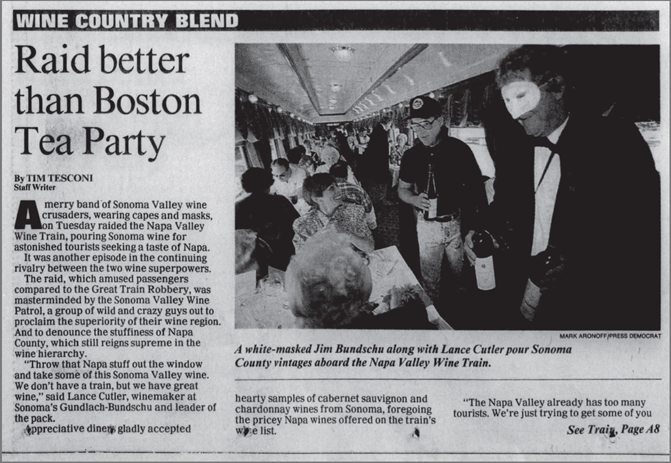
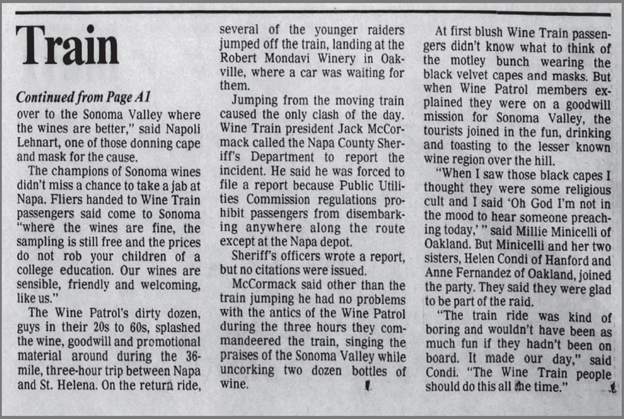
I believe the date was May 15, 1990, when a dozen of us showed up at the Wine Train Depot. We had invited Tim Tesconi, the Agricultural reporter for the Santa Rosa Press Democrat to document the escapade, and he joined us. We handed the porters our tickets and boarded the train. Each of us carried a canvas bag that held six bottles of Gundlach Bundschu wine. Once the train got rolling, we put on our masks and capes. Armed with corkscrews we wandered up and down the aisles of the train cars. We admonished passengers to “Throw that Napa swill out the windows and try some delicious wine from Sonoma. We don’t have a train, but we have great wine.”
As we poured free wine for the passengers, we passed out leaflets that read in part, “Come to Sonoma, where the wines are fine, the sampling is free, and the prices do not rob your children of a college education. Our wines are sensible, friendly, and welcoming; like us” We poured wine and entertained the passengers for the entire three hour ride to St. Helena and back. On the return trip, when the train slowed to a snail’s pace as it crossed the Robert Mondavi property, half of us leapt from the moving train where we had a driver and van waiting to spirit us away. Safely exiting that moving train may have been the most invigorating thing I’ve ever done.
Those of us in the van returned to the train depot to pick up the Wine Patrollers who remained on the train. As the train pulled into the station and we all joyously celebrated our successful raid, the Wine Train President, Jack McCormack, came over to tell us that disembarking a moving train was a federal offense. He said he was going into his office to call the Napa Valley Sheriff’s Department to report the incident as required by law.
Wine Patrollers are fun loving, but we are not dumb. Jack McCormack was doing us a solid, by warning us that he was calling the sheriffs. We made a hasty exit from the depot to our pre-arranged hideout: a restaurant just around the corner owned by a good friend, who previously owned a restaurant in Sonoma. As sheriff’s helicopters circled the sky looking for train hijackers, we comfortably sipped wine and ate tasty celebratory appetizers that our friend insisted on serving us. Once the coast was clear, we made our way back to Sonoma.
Tim Tesconi’s article came out in the Press Democrat the next day. He had done a terrific job emphasizing the whimsical nature of our raid. It was a fun thing for us and people in Sonoma found the whole story delightful.
A few days later, Herb Caen, the most popular columnist for the San Francisco Chronicle, wrote about Sonoma Valley winemakers donning capes and hijacking the Napa Wine Train. The story exploded. It was the equivalent to something going viral today. Radio, television, and newspapers called for details and the story raged for a weeks.
All the publicity instigated a visit from the Bureau of Alcohol, Tobacco and Firearms (BATF), the federal agency that dealt with liquor licenses. Two BATF agents interviewed Bundschu and me trying to get us to reveal the names of the other Wine Patrollers. We refused, even when they threatened to suspend our license to sell wine. They left and we had no idea whether they would pursue penalties. Thankfully, we never heard from them again.
The Napa Wine Train hijacking is one thing that everybody in the wine business still remembers. It was the opening salvo in the competitive battle between Sonoma and Napa. Even though most Napa wineries didn’t care less what these upstarts in Sonoma were doing, it resonated with reporters, wine salespeople, and consumers. Everyone loves an underdog. Like Magnificent Seven peasants, the Sonoma Valley Wine Patrol was standing up to the big guys, and we were starting to get attention.
In 1984, Jim Bundschu sent me to Los Angeles to see if I could jump start some wine sales. I worked with Jim McCullough who represented our wines through Seagram’s Chateau & Estate Wines Company. This was to be the last year we worked with Chateau and Estate, so we were also looking for someone to head up our sales program. We interviewed a few candidates, but no one really impressed us. After spending five days with Jim McCullough, I was sure he was the right fit for sales manager. He had experience, knowledge and passion for wine and he was a terrific salesman who knew how to work with distributors, set up programs, and locate key accounts.
The last event of the week was a wine tasting in Orange County where the two of us manned a table pouring Gundlach Bundschu wine. We were one of 20 wineries at the tasting. Just before the tasting, McCullough introduced me to Doug and Annie Diefenthaler. Jim knew the Diefenthalers from his days selling wine in Colorado. In fact, Doug took over Jim’s mountain territory when Jim moved on to become sales manager for Familia Torres Winery in the United States.
After the tasting, Jim, Doug, and Annie headed to Palm Springs to spend the weekend together. I returned to Sonoma and spent time in discussions with Jim Bundschu about how we’d move forward once we left Chateau & Estate. Eventually, based on my recommendation, Bundschu interviewed McCullough and offered him the position as Sales Manager for Gundlach Bundschu. After the interview, McCullough came over to my house for dinner. All he could talk about was this “Wine Patrol” concept he, Doug and Annie had come up with that weekend in Palm Springs.
They had spent that entire Palm Springs weekend drinking wine and tequila and talking about the state of the wine industry. Their inebriated discussions focused on the good guys: the dozens of small wineries run by dedicated people who were passionate about wine. Then there were the bad guys: large distribution companies and corporate wineries who controlled how wine was sold and focused on profits. The good guys, were like the peasants in the Magnificent Seven being held down and at the mercy of the big interests. They needed some tough High Plains Drifter types (Wine Rangers) to teach them how to stand up against the big interests who kept them stuck at the bottom of the totem pole. If those Wine Rangers could educate and train the dedicated but clueless winemakers in the ways of sales, they might have a fighting chance against the bad guys.
Those Wine Rangers would be called the Wine Patrol. The premise was that we could establish small outposts of trained patrollers who would go to war with the big distributors. They would serve as examples to others. This was the intellectual birth of the Wine Patrol. The concept of a Wine Patrol remained simple musings of friends sitting around drinking wine and talking about the industry until a series of disconnected events brought the concept into full bloom.
By 1996, Gundlach Bundschu had seen substantial increases in wine sales, and we were convinced that humor in our marketing would be successful and make us stand out. Jim McCullough and I decided to put together a seminar to teach small wineries how to deal with distributors, make calls on customers, and successfully sell their wines in various markets. We created a business entity to set up this training program. We registered our company as the Sonoma Valley Wine Patrol. I hired Chuck House to design a logo.
We put out notices and two dozen winemakers and winery owners signed up for that first seminar. Doug Diefentaler attended as a lecturer. McCullough explained how to set up programs with distributors. I focused on how winemakers could effectively use their time when working markets. We had them participate in role plays, changing buyer and seller roles. Unanimously, the participants loved the seminar saying it gave them ammunition to fight the good fight and sell their wares.
We told them they were the first rangers of the Wine Patrol. They needed to take what they had learned and successfully penetrate markets across the country. They needed to enlist like-minded people into the Wine Patrol. There was no set criteria for who these Wine Patrollers would be, but we assured them that they’d know one when they saw one.
Dennis Patterson was president of Ben Franklin Press which started as a small Napa print shop in 1983 and grew into one of Wine Country’s major wine label printers. They also printed the majority of our posters, but I hadn’t seen or heard from him in over 30 years. When I decided to write about the posters, I finally tracked him down living on a boat near Punta Mita in Mexico.
“Working with Chuck House was great,” he said. “So many designers at that time were desktop publishers using the different fonts and they would design things without any idea about what they were doing. I had to explain that printing was a whole different thing from what they saw on their screen when they wanted to print 100,000 of them and put them on bottles. It had to work on the bottle. Chuck understood all that stuff, and if he had questions, he would ask me. I appreciated that interaction and creativity.”
Chuck House liked working with the people at Ben Franklin Press, so when we came up with the poster idea, he suggested them for the job. Dennis told me, “Producing the posters was one of the best times I had working in the business. Working with you and Chuck and Ron Zak, the creativity and interaction was really enjoyable. It wasn’t like working with all those egos in the wine industry, instead it was people who were collaborating to produce something unique. I still think “Valley of the Moon” is funny.
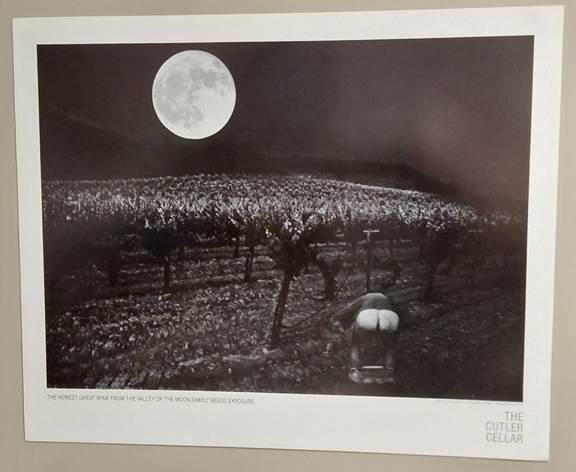
“Valley of the Moon” was the first Cutler Cellar poster. Inspired by a famous poster entitled “Expose Yourself to Art” by M. Ryerson. It features classic two-shot photography, printed seamlessly by photographer Ron Zak. Using crisp shadow and light effects, it has an Ansel Adams feel to it.
“The Cutler Cellar, the newest great winery from the Valley of the Moon simply needs exposure.”
The model with his pants down was Bill Klegg, who was 6’6” or taller. We needed that for proper perspective. He stopped by my house to pick up copies of the poster hot off the press. He sat on our couch with feet on the floor, his knees poking up in the air and bouncing with his uncontrolled laughter.
Ron Zak explained, “I had two separate photographs: one of a full moon and another with the guy in the vineyard dropping his drawers. I merged them together as best as possible. That was all done in the darkroom, pre-photoshop.”
Chuck explained, “Lance was my first introduction to the wine business. I’ll always be super grateful for that. That led to Gundlach Bundschu, where I was really learning on the job. I had no idea what I was doing, but I loved it. As for the posters, they weren’t coming from me. It was more of a problem solving mission, because the work had already been done. The photos had been taken, the concept was clear, and then it was just a matter of communicating that and disappearing myself in the process. Once we started, I loved it. I loved working with Lance, Ron, and Dennis.”
Chuck said his participation with the posters was more of a liaison with Dennis making sure that the prints were the right size, and the right color with the right paper. Dennis had one of the old school printing presses that had a lot of flexibility. He was very much involved with Dennis and getting the printing aspect of it working.
“I wasn’t part of creating that imagery,” Chuck explained. “It was more like here is our idea and here’s the photo. I was just trying to find a way in. It was a good challenge to do something different, but a lot of it was working with the press operators and the ink and the color, because I wasn’t very experienced with that. Labels go onto a bottle of wine. These posters had to stand on their own, so there was more pressure. It was more difficult in that sense to do the posters than to do labels. The posters I like the most are the ones where there is the least of me involved. That Valley of the Moon poster was pretty cool. I was using a sans serif font for that and put it off to the side, so it looked rustic and modern. I was learning on the job, I wanted to find something that I was interested in. You have to be interested in what you are doing in order to be successful.”
Chuck felt the posters were more problem solving, trying to get the idea to the public in the least objectionable format possible. There’s a lot that goes into developing a proper framework for a successful poster. It’s problem solving, not blue sky imagination, but those are all the things you need to learn. “It was more like a laboratory of learning how to do that stuff that was exciting to me,” Chuck explained. “It was not I’m going to imagine something brilliant and creative here. It was more like OK, I can do this.
“For me, the real benefit was the hands on work in the print shop, which many designers now have no idea about. Even at the top level, they will just be sending off files that make no sense whatsoever other than looking good on the screen. To me, being at that right place with Lance at the right time was very instrumental, and I’ve been using that knowledge ever since. Those were really formative years for me, and it was a great experience to be able to work on those. My job was just not to mess it up too much.”
This is classic Chuck House deniability. In reality, his design contributions turned our pedestrian ideas into art. It seemed like a joint product to me. We all contributed, and that took a lot of pressure off. I always looked forward to working on a poster project. It was fun to work with such talented artists, and we created something unique that has never been duplicated in the wine business.
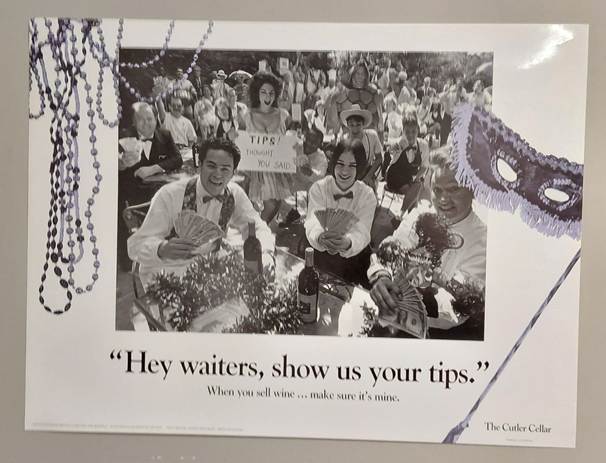
Because of our relationship with Jerry and Catherine Henry, New Orleans has become our second home. In the past 40 years, close to four years of our time has been spent in the Big Easy. I had done hundreds of winemaker dinners at various restaurants in the city and throughout the state. I worked fundraisers for the local opera and sponsored a four-day trip to Sonoma for the Jazz and Heritage Youth Band. We provided lodging and food, got them a gig at Sea World in exchange for their getting to spend a day in the park, and finished with a concert at Gundlach Bundschu Winery for more than 300 people. In 1990, the City Council made me an honorary citizen of New Orleans because of all the work I had done in the community. It’s an honor I don’t take lightly. Along with Jerry and Catherine, we sponsored an annual party for New Orleans waitstaff called the Waitstaff Ball.
This poster was my thank you to all the waitstaff who had turned New Orleans into the single largest market in the United States for The Cutler Cellar wines. Most waiters are nocturnal creatures. That we were able to draw so many to our morning photo shoot, some dressed in costumes and others in work dress still amazes me. Not only that, but the entire sales staff from our distributor showed up just to be in the poster. The morning exuded a true sense of camaraderie. We all realized we had worked together to create something unique in the wine business, and we had fun doing it.
Ron Zak managed the unruly crowd until he got a great shot. Chuck House added a Mardi Gras mask and beads with a hint of color, which made the entire poster and project undeniably New Orleans.
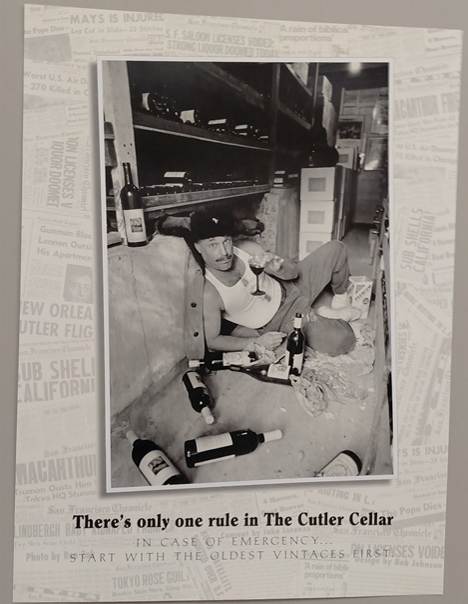
The last Cutler Cellar poster features me in my famous wine cellar. It’s in the same location as my daughter’s poster, but the feeling is completely different. The wine bottles scattered around, crumbled saltine crackers, the winter hat with the Russian star, and the wine-stained shirt; there’s just something about the picture that makes me laugh.
Chuck was unavailable for this poster, so I went to another talented local artist, Bob Johnson, the exceptional wine cartoonist, and illustrator. The caption was a quote I had often used, “There’s only one rule in The Cutler Cellar, in case of emergency . . . start with the oldest vintages first.” Bob surrounded the photo with dozens of newspaper headlines declaring various disasters. My favorite is the one about Willie Mays getting injured.
The posters were an enormous success and great fun. Compared to the pressure and sometime drudgery of making wine, the posters were like playtime for me. I worked with enthusiastic, talented artists and we bounced ideas off each other from start to finish, looking for ways to improve each poster, to make it funnier or better. We all contributed, and that took a lot of pressure off.
“Collaborating with other people is great,” said Zak. “You get all the different inputs without any ownership issues. We’d get an idea and imagine how it might look. Putting the ingredients together and pulling it off was a thrilling process, and the process is always the best part of any project. For me, the entire poster series was one of the most exciting things I ever did.”
The posters and our humorous approach to wine marketing were so successful and popular that Sonoma Valley adopted it for their annual wine auction, even hiring Ron Zak to do the photography for posters. I helped coordinate the first couple of shoots and dealt with Dennis at the printers, but soon I was out of the wine business and more focused on my writing.
After I left, the Bundschus produced two or three more posters, but eventually decided to move away from outrageous humor and skirmishes to focus on their earned place in history as one of the storied, longest enduring wine families in California.
Looking back, I wish I had written this sooner while my memory was sharper and the details were clearer. At least I got this part of the story told and documented, and most of the posters are now displayed in one place for all to see. Otherwise, no one would believe it.
In 1992, prohibitionist sentiments were making the news. Led by Mothers Against Drunk Driving (MADD) people were calling for bars to close earlier, restricting alcohol at public events, raising the drinking age from 18 to 21, and lowering BAC levels for what qualifies as drunk driving. I was certainly opposed to drunk driving, but these people had taken things too far. A poster idea popped into my head. I pitched it to Jim Bundschu, but he felt it was too controversial for Gundlach Bundschu, so I went ahead with it as a Cutler Cellar Poster.
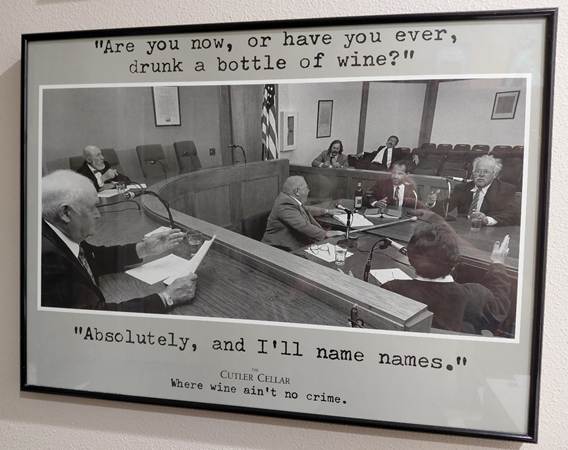
This is the poster that sits on my office wall and finally got me to start writing again. My landlord, Bob Bonino is in the left fore-corner. Dr. Wayne Price sits to his left. The lady with her back to us is Rena Lehnert of the Cherry Tree Juice stand. To her left Edward “Ski” Krensjewski. Ski was a legend in Sonoma. Bartender at the old El Dorado Hotel, Ski served Ernest and Julio Gallo when they made their annual trips to Sonoma. He was exclusive bartender for all of Hap Arnold’s private parties, and one of the genuinely exceptional story tellers ever. Claude Berthoud is my defense attorney. Good friend Herb Lane sits asleep in the audience section. Dennis Patterson, the gentleman who printed all our posters, takes notes near the American flag. (Only Dennis and I remain alive today.)
The poster depicts a courtroom scene. A group of elderly, hostile judicial types question me. I am defended by my unflappable attorney, Claude Berthoud. The caption reads, “Are you now, or have you ever drunk a bottle of wine? The answer is “Absolutely, and I’ll name names.”
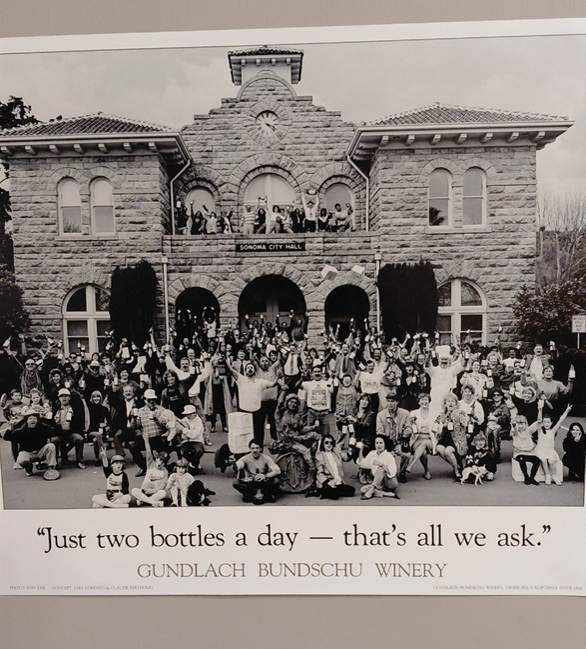
It was a great, fun-filled shoot with lots of energy and good humor. After the shoot, I took the cast out for lunch at the Depot Hotel Restaurant. It turned into one of those unforgettable afternoons. We had plenty of Chef Mike Ghilarducci’s great food and sucked down several bottles of fine wine. There was laughter and good cheer. One of Claude’s lines became an anthem for the afternoon. When we ordered the second bottle of wine early in the afternoon, Claude said, “Just two bottles a day, that’s all we ask.”
We roared. Every time we ordered another bottle we would all say “Just two bottles a day . . .” By the end of the meal, we could order a bottle of wine by just saying, “Two.” We all went home, but another poster idea was festering in my mind.
A few months later, Gundlach Bundschu hosted a luncheon for 150 locals in the Community Center. We explained we were enlisting them as models for a new poster and marched them to Sonoma’s historic City Hall for a photo. Zak was at his best, exhorting us in his overly exuberant way. All the people held bottles of wine. Our kids were there dressed for Little League or dance recital. People were shouting “Two!” and waving their arms, holding up two fingers. The caption for the poster read “Just two bottles a day, that’s all we ask.”
It was great fun, involved a huge part of the community, and for weeks people commented on how much they had enjoyed the afternoon. We couldn’t wait to distribute the poster so our friends and neighbors could have a copy.
On October 9, 1992, the Sonoma Police Professionals Association issued a letter. This letter was sent to the media, to City Hall and to various regulatory agencies. The letter said, in part:
“Should city property and young children be used to advertise the use of alcoholic beverages? We have seen a very disturbing poster, which does this very thing. Is this what we want our children to believe? Every day, we see the tragic results of the abuses of drugs and alcohol in our city and our society. We support the educational efforts by schools and other agencies in an effort to inform our children of the horrible dangers of overindulgence in the consumption of alcohol. Do we want our children to see us standing on the balcony of City Hall with jugs of wine trying to tell everyone it is OK to overindulge?”
On October 16, 1992, Tim Tesconi published a front page story for the Santa Rosa PressDemocrat. The story included a picture of the poster and reported that Donald Rowe, president of the Association was asking that the posters be destroyed.
Representing the winery, Jim Bundschu said that he couldn’t believe anyone would take the poster seriously. He said the poster was a joke. “Don’t people read political cartoons in newspapers?”
Monday, October 19, 1992. Again, the poster finds its way into the press, this time in a story in The Wall Street Journal that discusses the clash of wineries and government over health claims attributed to drinking wine. It quotes Jim Bundschu as saying he believes the industry should let the entire health issue fall by the wayside. Jim said, “To promote wine as healthful or detract from it because it’s unhealthy misses the point. Wine is good for the human spirit and the soul . . . now let them take that away.”
Tuesday, October 20, 1992. Sonoma’s local paper, the Index Tribune, comes out with a front page story. Again, the poster is printed. Now, Association representatives claim that groups such as MADD and Social Advocates for Youth are applauding the Association’s stand. Bundschu requested that no one in the winery make any statements to the press except him. He says he doesn’t want to make a big issue out of this, because it is a local brouhaha, and he thinks it best not to split the community.
Wine writer Jerry Mead and others are writing to support the winery. Supporters point out that less than 2 percent of drunk drivers nationally are arrested under the influence of wine, and the incidence of drunk driving in Wine Country is no greater than in other areas of comparable population density. Gundlach Bundschu receives a few very antagonistic calls, but the majority support the winery and “just don’t understand all the fuss.”
My immediate reaction was to make a couple of new posters. One would depict the Bundschu clan dressed like 1920s gangsters in front of a wall of our wine. In their arms are giant corkscrews, held like tommy guns. The caption reads, “Come and get us, coppers.”
The other poster idea was to reconvene the same 150 people in front of City Hall. This time each would raise just a single middle digit, and the caption would read, “Okay, just one bottle a day.”
Instead of posters, I ended up writing a long explanation of how this all came about. It ended with this, “For those of us in the wine business, wine is our life. Our lives proceed one vintage at a time. You can tell when our children were born by looking in our wine cellars. We mark their births by harvest conditions: Jack was born in ’89, the vintage from hell; Jill was born in ’85, a perfect growing season. We track the notable events in their lives through the growing season: he started school when we had that incredible frost in the ‘90s; she starred in the school play when we had early bud break in ’87.
“For those of us who make wine, it is impossible to separate our lives from our produce, because when we drink the wine we make, it starts memories of our very lives flowing through our veins.
“When the government tells me I’ve got to put warning labels on my wine, I comply and counter with a humorous poster. When people tell me that wine at my table is a sure sign that I am an alcoholic, I laugh and go about my business. But when my children come home from school to report their teacher says wine is a drug like cocaine or heroin, then I am righteous in my indignation, because the very survival of my family is at stake.
“For the past several years, those of us who enjoy wine have been under attack. We conceived the poster as a humorous way of defending ourselves and reminding all of us how much we love wine and appreciate the life it provides each and every one of us.
“I sincerely apologize to anyone who participated in this project for any pain or embarrassment caused by the reaction to this poster, but if doubts cross your mind for even a second, just look at the poster and think back to that day. You will smile remembering the excitement of your children and grin at the poses of your dogs. You’ll enjoy seeing your friends and neighbors, and you’ll remember the sense of fun and community we shared. Finally, you’ll laugh at the thought that anyone could take this seriously.
“Sonoma was the birthplace of wine in California. The vineyards around us are our last line of defense against runaway growth. Winemaking stands at the heart of the Sonoma lifestyle and economy. The Sonoma way of life is a gift, directly attributable to winemaking and grape growing. It is a gift those of us in the industry gladly share with everyone.
“All we ask is that they understand from whence the gift comes. It is no less than our very lives and the lives of our children. That’s the magic in the bottle. That’s the treasure we hope to share.”
The poster series happened close to 40 years ago, but most of it is lost to history. I thought it was important to document how the posters came to pass, acknowledge the people who participated, and share the good humor and sense of joy that infused the project. Every poster idea surfaced from our lives making wine in Sonoma Valley. All the models were our neighbors and friends. It was a time before cell phones and the internet. The photos were shot by a talented photographer using a real camera filled with actual film. Photo proofs were printed, pictures got selected, and we developed the prints in a dark room.
Lately, after recently being locked into my home because of COVID, listening to resurfacing prohibitionists talk about how bad wine is for you, seeing grapes go unpicked, and watching vineyards being ripped out, I could use a funny poster right about now. I always thought laughing in the face of adversity was a healthy response. Couple that with friends, a bottle of wine, and a delicious meal and I think we will have a chance of getting through these dark times unscathed.
What do you get your daughter for her 21st birthday?
I got my daughter, Dawn, her very own poster.
We moved to Sonoma in 1977. For the next 23 years we lived in a tiny 864 square foot house on two acres of land. Bob and Mary Bonino were our landlords, and they lived on the property with Mary’s mother, Josephine. We moved in when Dawn was seven and they quickly treated her like the granddaughter they never had.
The house was so small, we couldn’t fit beds into it, so we were forced to use futons, which could be folded up into couches when we weren’t sleeping. Despite its size, that house saw more than its share of entertaining. We would either crowd our guests into the tiny kitchen for a multi-course dinner or, if the weather permitted, we would dine outside on the porch. Underneath the house was an old root cellar, which created a perfect space for my wine cellar. Bob Bonino helped me make the racks, and I quickly filled them with hundreds of bottles.
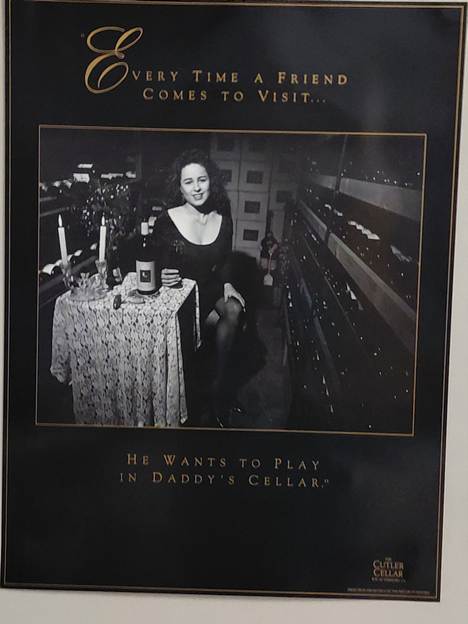
Because I was often busy at the stove preparing the meal, I would ask our guests to go down to the cellar and pick out a few bottles of wine. Nothing was sacred. They could select whatever struck their fancy, so long as they didn’t lose themselves in indecision, depriving those of us waiting in the house for some wine. That tradition led to the poster idea, “Every time a friend comes to visit . . . he wants to play in Daddy’s cellar.”
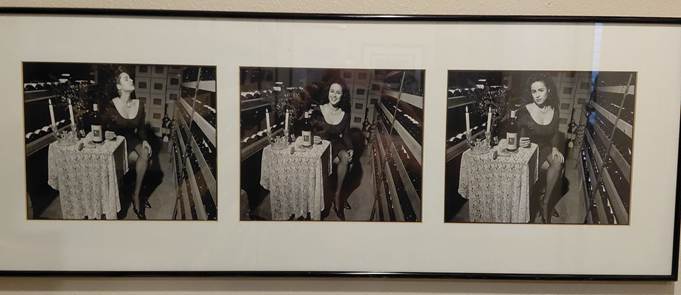
Dawn and I went to a fancy women’s clothing store in town where she selected a dress. We set up a little table, placed flowers, candles, a corkscrew, and a bottle of Cutler Cellar on it, and Ron Zak started taking pictures. It was not an easy shoot because it was freaking cold. Every 10 minutes or so, Dawn and Ron would run up into the house to warm themselves by the heater. It was so cold that the melted wax we used to keep the candles straight kept freezing, and the candles constantly tilted over.
Ron took dozens of photos capturing Dawn in dramatic poses and with a wide series of expressions. He made 8x10s of several selections, and it became difficult to select one for the poster. Here are three shots that didn’t make the cut. On the far left, the candles are almost straight. The other two shots, not so much.
Once we selected the photo, we got Chuck House involved. He created a sophisticated effect by using gold print and borders around the photo and the poster, but it still wasn’t working, until he placed the script “E” to start the caption. Suddenly, as if by magic, everything fell into place and we had a beautiful poster.
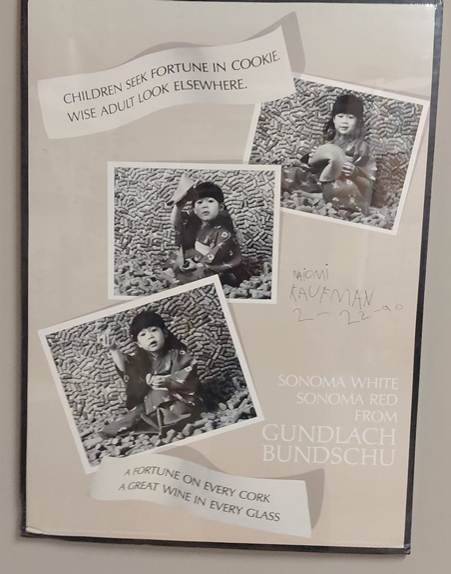
My Goddaughter, Naiomi Kaufman got her poster when she was three. Her father, Ray Kaufman and I have been friends for 60 years. We met in college where we were very politically active. After several arrests, court trials, and graduation, we couldn’t wait to leave Los Angeles. Ray ended up in Asia for seven years. I ended up in Wine Country.
Ray returned from his sojourn with a Japanese wife. He tried living in Los Angeles, but it wasn’t to his liking. I invited him to come visit us in Sonoma. He liked the area, was fascinated with the wine business, and eventually moved here. Ray went on to become co-winemaker at Laurel Glen Vineyard, working alongside Patrick Campbell. He started a wine export company which placed virtually every well-known California winery into Europe and Asia, and he purchased a 60-year-old Malbec vineyard in Argentina using it to create his Adelante brand.
Meanwhile, at Gundlach Bundschu, in addition to all the varietal wines we made, we introduced two blends: Sonoma Red and Sonoma White. Grapes from our youngest plantings, vines growing in our weakest soils, barrels that didn’t fit into our varietal program, and plain extra wine went into those blends. The wines were delicious and verry inexpensive.
I believe Jim Bundschu had become fond of looking up famous quotes from well-known people. He would regale us with sayings from Mark Twain, Carl Sandburg or Ben Franklin. McCullough said we should put the sayings on our corks, so we did, but only on the Sonoma Red and Sonoma White wines. It was great fun.
We selected ten different quotes every year, and we called the corks “Fortune Corks.” We invited everyone to come up with quotes we could put on the corks. Year after year, we were flooded with celebrated quotes from waiters, salespeople, and wine shop owners. It made them feel connected to the winery, especially if one of their quotes was printed on an actual cork.
Leave the kids the land and the money. Drink the wine yourself.
Wine is constant proof that God loves us and loves to see us happy.
A woman drove me to drink. I never had the courtesy to thank her.
If you drink, don’t drive. Don’t even putt.
If you want your place in the sun, expect a few blisters.
After a couple of years, we realized that many people drank our Sonoma Red and White without noticing the fortunes on the cork. We needed to let them know. Perfect excuse for another poster. I glued hundreds of fortune corks onto a sheet of plywood, then we enlisted Naiomi to be our model. She sits, dressed in full kimono, in front of the wall of fortune corks. She holds a gigantic fortune cookie.
Children seek fortune in cookie. Wise adult look elsewhere.
Sonoma Red and Sonoma White
A fortune on every cork. Great wine in every glass.
I got Naiomi to autograph and date several posters as soon as she learned to write. I saved those posters and presented them to her upon her graduation from high school. Naiomi is now an attorney collaborating with a small private clientele living in San Diego, but she still visits for Thanksgiving, Turkey Taco Day, and Christmas.
The first territory that McCullough assigned me was Denver and the state of Colorado. Because he had lived and worked there for years, I walked into a large group of his friends, all of whom loved wine. Footers Restaurant was one of the top wine accounts in Denver. It was owned by Jimmy Lambatos, who went on to start Quiznos sandwich shop. Running the bar and serving as prime wine buyer was Lisa Weber. Lisa loved Gundlach Bundschu wines, enjoyed our humorous approach, and appreciated my doing winemaker dinners at the restaurant.
Lisa wanted to learn more about how wine was made. She worked out a deal to stay with Andy Cutter at Duxoup Wine Works in the Dry Creek Valley to experience harvest. She stopped by the house to visit and told me that something had come up. Andy Cutter wouldn’t be able to host her. I invited her to stay with us and learn about harvest at Gundlach Bundschu. She accepted the invitation, even though our small house required her to sleep on the couch.
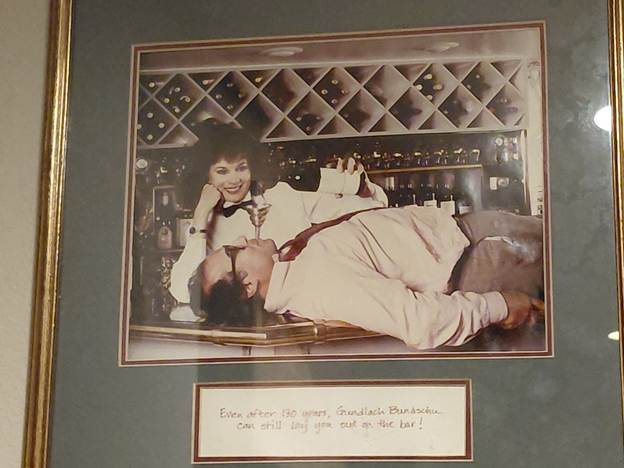
Dawn was still living at home. She and Lisa hit it off and became good friends. I told Dawn it was like having an older sister. After a few weeks staying and helping during crush, Lisa returned to Denver and Footers. Just to show how our posters had infiltrated the thinking of our customers, for Gundlach Bundschu’s 130 anniversary, Lisa and Jimmy Lambatos sent a photo with a caption that could have been a great poster. Jimmy is lying flat on a bar with a funnel in his mouth. Lisa is pouring our wine into the funnel. The caption reads. “Even after 130 years, Gundlach Bundschu can still lay you out on the bar!”
Lisa eventually moved out to California and became a sort of surrogate daughter. She would come for all holidays and major social occasions. She’d help pick and produce Guerrilla Vino wine, and most importantly she agreed to edit all my writing from the Tequila Lover’s Guide through all the Jake Lorenzo books and most anything else I chose to tackle.
Eventually, Lisa moved to Washington State, near Dawn, and has recently retired from work. She spends her days walking in forests and along trails photographing anything of interest and sharing it with friends on Facebook.
A boom of fine dining restaurants coincided with the explosion of interest concerning California wine. Chefs who had immigrated from Europe were opening fancy restaurants without liquor licenses. Their customers back home were happy just drinking wine with their meals, they figured Americans should be content as well. There was no need to provide alcoholic cocktails and pay the exorbitant license fees for hard liquor. These restaurants provided a great untapped market for California wines, and our posters had helped us get entrenched on restaurant wine lists.
Distributors across the country who had focused on hard liquor sales realized that wine was a growing market. To risk being left at the station in the face of a wine boom, they had to bring California wine into their portfolios, train their salespeople, and reap the benefits of wine’s growing popularity. Distributors would come to Wine Country with their entire sales staff, visit wineries that they represented, and make pitches to new wineries they hoped to bring into the fold.
The sales teams would arrive at a winery, listen to a speech from a principal or owner and then suffer through an elaborate tasting of the winery’s entire lineup of wines. Since more than 70 percent of the salespeople were long-time hard liquor salesmen and had no interest in selling wine, they were often inattentive and bored out of their skulls. They sold established liquor brands, and the flavor of those brands never changed.
A sales staff visiting Gundlach Bundschu discovered a very informal affair. Music would be blasting, and giant Weber barbecues would cook delicious sausages from Sonoma Sausage Factory. Both red and white wine would be poured, but ice chests filled with local micro brews dotted the premises. We’d explain, “It takes a lot of good beer to make great wine.” McCullough was convinced that liquor salespeople were dinosaurs and would be of no help to us. He taught us to recognize the few salespeople interested in wine. The concept of learning grape varieties, vintage differences, and the varying flavors imparted by the different barrels used fascinated them.
The more information we gave them, the more rivetted they became. Instead of boring formal tastings, we herded them into our cave and let them taste directly from the barrels. We’d put them on the bottling line, show them how to operate the press, and let them help clean the lees filter. During harvest we’d drag them into the vineyard, hand them grape harvesting knives and let them pick grapes. They loved it. They related to our humorous approach, saw we were different from most other wineries, and they became our ambassadors into the markets across America.
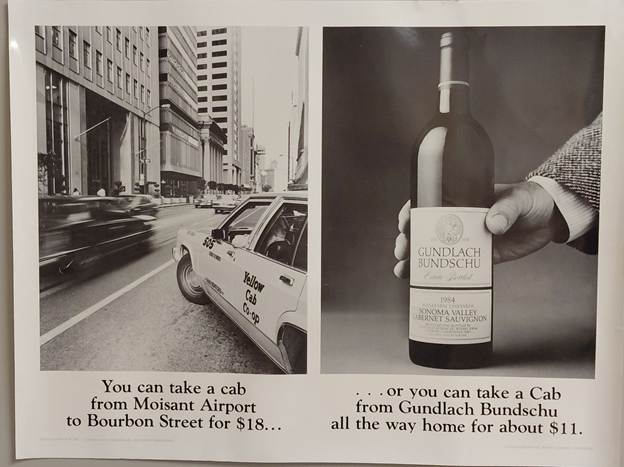
We decided to pay tribute to the salespeople doing the best job selling our wine. We also felt the time was right to enter the Cabernet Sauvignon fray. We created a two-shot poster showing a taxi on a busy, generic downtown street next to a hand holding a bottle of Gundlach Bundschu Cabernet Sauvignon. We did eight different posters for eight separate cities. The photos remained the same, but the captions changed. You can take a cab from Moisant Airport to the French Quarter became a cab from Sea Tac to the Space Needle or a cab from Logan Airport to Faneuil Hall. Take a Gundlach Bundschu Cab all the way home really resonated, especially for just $11, and the locals respected that we knew the iconic destinations of each city.
McCullough worked the markets tirelessly. He insisted that Bundschu and I help him by visiting various markets. “They could care less about the sales manager,” he said. “They want to spend time with the owner and winemaker.” Bundschu was more reluctant, but I discovered I loved visiting people and working the markets, and I was good at it. Over time, we had identified key salespeople in every market. Visiting them on their home territory, working with them in their accounts, and having them visit us in Sonoma forged dynamic friendships.
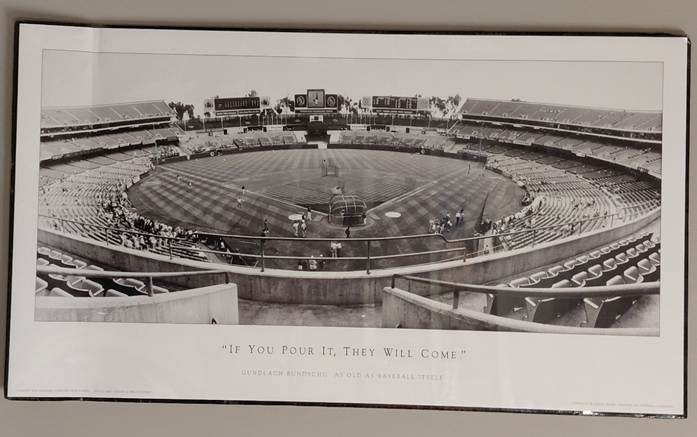
We felt that we were part of a secret adjunct of the wine business, one of quality, value, fun and good humor. Our key wine salespeople became good friends. We spent lots of time together, created the Wine Patrol trips to thank them, and encouraged them to participate in our sales and marketing whenever they could. Ron Paradise was our key salesperson in Kansas City, Missouri. He’d take us to the best barbecue restaurants, introduce us to legendary jazz locations, and get us tickets for baseball games. One day, while at a Kansas City Royals game, he came up with the line, “If you pour it, they will come.”
Returning home, I contacted the Oakland A’s seeking permission to take a photo of their stadium for our poster. They denied the request. We sent Ron Zak to the Oakland stadium to take a photo anyway, but either Ron was nervous about not having permission, or didn’t understand baseball. We felt none of the photos would work for a poster.
I rented a camera equipped with an 180 degree lens aperture. The camera was noisy and heavy. You’d click the button to take a picture, and the shutter would swing across the lens in an arc. McCullough and I went to Oakland Stadium early for batting practice. I found it was impossible to keep the camera steady throughout the entire shot. Finally, I rested the camera on a short concrete wall above an exit stairway. It gave us a steady platform to get the picture.
Once we had the photo, we turned it over to Chuck House. He really went to town on it. The center field scoreboard has a picture of a bottle of Gundlach Bundschu wine flanked by Bundschu logos and a Gundlach Bundschu banner on the bottom. The scoreboard to the right is bracketed by Cutler Cellar logos with a banner showing “gun, lock, bun, shoe.” The scoreboard to the left touts Sonoma Valley Vineyards, where great wines are born. Sonoma Valley Wine Patrol logos flank the score which shows Vineburg beating St. Helena 8 to 0. All the advertising signs have been reimagined. The more you look the more you see.
At the bottom, we credit Ron Paradise with the concept, attributing it to Cow Town Wine Patrol. Because we had been denied permission to use the image, McCullough and I used pseudonyms of Diego Sonoma and Jake Lorenzo on the photo credit. Finally, McCullough came up with the classic line, “Gundlach Bundschu. As old as baseball itself.”
Months later, we were contacted by a couple of Oakland A’s players. They had seen the poster and loved it. They sent free tickets to a game and asked us to bring copies of the poster. We got there early, went to the club house, gave them a stack of posters and left with a pile of A’s gear. Never had any repercussions from Oakland Stadium for using an unauthorized photo.
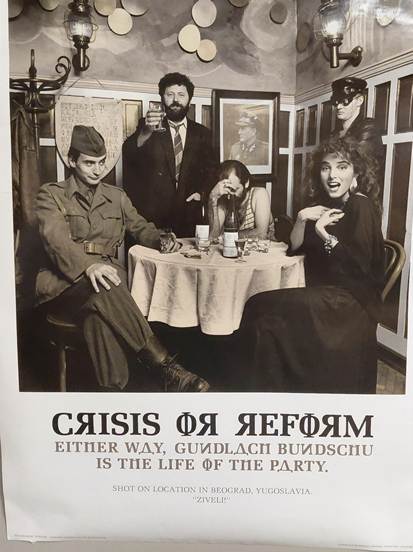
We felt bad about not using Ron Zak’s photos for the baseball poster. We were able to make it up to him with our next project. Ron landed some sort of mentorship in Yugoslavia teaching photography. He told us the whole time he was in Yugoslavia, he couldn’t stop thinking of ideas for posters. He came back with a terrific photo which we turned into the “Crisis or Reform” poster. All the models in the poster were students in Ron’s class.
Chuck House made things entertaining and interesting with a really unique font, letters turned backwards and a lightly colored sepia ink printing lending the whole photo a dusty Eastern European sensibility. “Either way Gundlach Bundschu is the life of the party.”
Once again, I am reminded how long ago this all happened. Yugoslavia is no longer a country. Moisant Airport is gone from New Orleans, replaced by Louis Armstrong International Airport. Ron Paradise is no longer with us. The baseball stadium is deserted and the A’s play in Sacramento at a minor league park on their way to Las Vegas. And $11 Cabernet . . . come on.
It’s enough to make you drink. At least I have a cellar full of good wine.
In the 1980s and 90s the wine boom was driven primarily by two varietals: cabernet sauvignon and chardonnay. Retail stores would often carry other varietals, but restaurants focused on cabernet and chardonnay. McCullough insisted that placements on restaurant wine lists were the key to success. Having your wine on a wine list gave your wine that verifiable third party endorsement guaranteeing the wine was good and worthy of the customer’s attention. The problem was that almost every winery in California was fighting to place their cabernet and chardonnay on those lists. The competition was intense, and if you got your wine placed, it would appear among a lengthy list of wineries.
McCullough reasoned that if we could place alternative red and white wines on restaurant wine lists, there would be less competition, and our wines would stand out. The poster series had taught people, especially waiters and wine salespeople, to pronounce our winery’s name. We figured if we could get wines on wine lists, waiters would happily sell them. We opted to focus on merlot as our red wine.
Merlot was an easy drinking red wine, more easily accessible than cabernet because it had less tannin. Most merlot producers blended cabernet into their merlot just to add some tannic backbone. Rhinefarm merlot was unique, because it had plenty of tannin, which gave the wine added weight and a long finish. Instead of blending with cabernet sauvignon, we’d mix different blocks of grapes from within the Rhinefarm to achieve more complexity while still producing a wine that was 100 percent merlot.
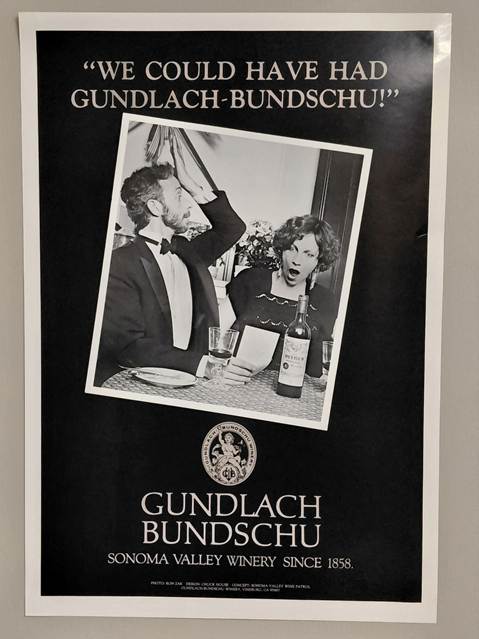
We needed a poster to launch our assault for space on restaurant wine lists. We decided to feature Chateau Petrus, arguably the most famous merlot in the world. An elegantly dressed couple has just been presented with the bill at the end of their meal. They are shocked at the price. “We could have had Gundlach Bundschu!” The poster aligned our wine with the finest merlot in the world and then emphasized that it was a bargain for similar quality.
James Patrick plays the gentleman. James wanted to learn about winemaking and would often come to the winery to help me with late night press loads. Kristin Anneker is his date. Kristin had dreams of making costumes for Hollywood movies. She created and produced the black velvet capes we all wore when we hijacked the Napa Valley Wine Train, and she ended up in Hollywood working as a successful costume designer for years.
Gundlach Bundschu Merlot found its way onto hundreds of wine lists. Often, the only other merlot offered on the list was from Duckhorn Vineyards, and the two of us became recognized as the two finest producers of merlot in California.
The merlot assault for space on wine lists was a tremendous success. We needed a white wine as well. Gundlach Bundschu was one of the few wineries to produce gewürztraminer, and most of the other producers made their wine sweet. Ours was bone dry, which made it a worthy compliment to all kinds of food. gewürztraminer is a strange grape to grow. The clusters tend to bunch up around the center of the vine making it hard to harvest. As the grapes ripen, the skins turn pink, and all at once (around 21 to 22° Brix) the acid drops out of the grapes overnight. We’d pick at those low sugars (something no one else was doing in those days) to retain what acidity we could. The resulting wine was clean and crisp with sparkling aromas of lychee and spice.
Maybe we were a bit cocky and overconfident, but we were on a roll. We decided to make gewürztraminer our white wine entrée to restaurant wine lists. We reprinted more of the Sobriety Test posters and took them with us when we called upon restaurant buyers. Our restaurant calls were unusual to say the least. We’d walk in with our local sales rep, get introduced to the wine buyer and bring out our bottles of merlot and gewürztraminer. Since almost every other wine rep was trying to place cabernet and chardonnay, we stood out from the crowd immediately.
We’d taste the wines and buyers would immediately relate to the quality of the merlot, but they’d also be stunned by the versatility of our dry gewürztraminer. When possible, I’d have them bring something from their menu and have them taste it paired with the gewürtz. The smoked soft shell crab at Christian’s Restaurant in New Orleans was the perfect pairing, so much so that at least four restaurant reviewers mentioned the pairing when writing about the restaurant.
It was an amazing thing to be sitting in a restaurant and hear a table burst into laughter when the waiter told them, “If you can’t say Gundlach Bundschu Gewürztraminer, you shouldn’t be driving.” In New Orleans, we hosted our first Waitstaff Ball on a Thursday night. The free event, exclusively for waiters, started at 10 PM, after dinner service. We had chefs from around town cook food, Charmaine Neville’s Band played, Gundlach Bundschu wines were served, and 300 waiters attended. The Waitstaff Ball ignited sales of Gundlach Bundschu in New Orleans. Mr. B’s restaurant sold three cases of Gewürztraminer the following weekend alone. Our sales soared from a respectable 1,000 cases a year to 3,000 cases per year, and they stayed there for seven years.
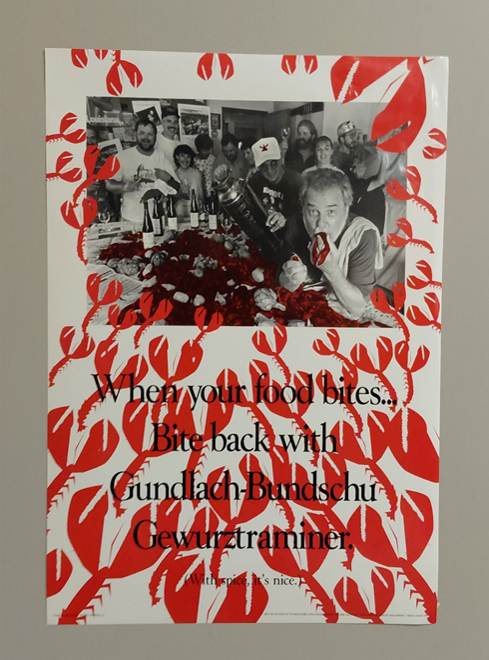
As a reward for our success with gewürztraminer on restaurant wine lists and to thank our New Orleans friends for their unwavering support, we created a second poster for gewürtz. We show our New Orleans friends at a crawfish boil, “When your food bites . . . Bite Back.” The scene is in Jerry and Catherine Henry’s garage. Depicted guests include family members, restaurant owners, and even two wine salesmen from a rival company. Chuck House came up with the idea of adding crawfish he had drawn all over the poster and using red for some color emphasis, making this unique among the entire poster series.
Once we had a foothold on restaurant wine lists with our merlot and gewürztraminer, and restaurant customers were buying the wines consistently, it became much easier to get those restaurants to add our other wines to their list. Gundlach Bundschu became synonymous with excellent, good value Merlot. Our merlot was so popular that we had to put it on allocation to protect our wine list placements.
We wanted to bring another red wine to the game. Cabernet franc was one of the newer plantings on Rhinefarm. I had hoped it would add some complexity to our cabernet sauvignon while taming the tannins. Instead, we found we had a very tannic cabernet franc. Still wary of entering the overly competitive cabernet sauvignon fray, we went with cab franc. The firm tannic backbone provided by the soils of Rhinefarm, made Gundlach Bundschu Cabernet Franc a delicious alternative.
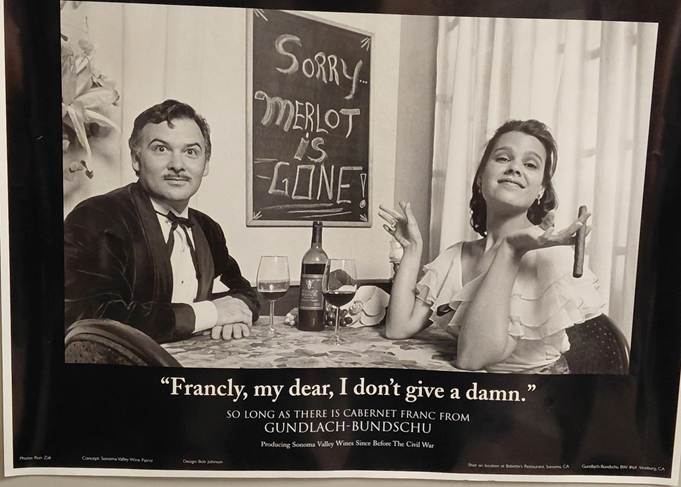
A waiter and waitress from the extremely popular Piatti’s restaurant in Sonoma agreed to be our models. Poking fun at our precarious merlot supply, we riffed off a Gone with the Wind line, “Francly, my dear, I don’t give a damn.” Unique to this poster is the newly revamped Gundlach Bundschu label adorning the bottle. McCullough and I loved this new label, but the Bundschu family decided to return to the more staid old format.
The poster program turned out to be an unqualified success. Our first two posters focused on teaching people how to pronounce the name of our winery. The third threw down the gauntlet declaring we were serious about making wine but had a sense of humor about it. We discussed how to continue with the series and decided we should introduce some of the key players.
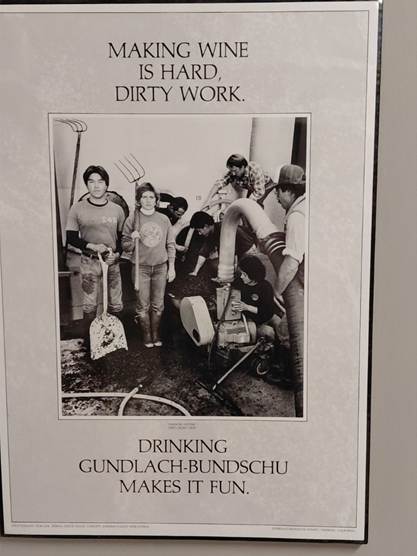
Using Grant Wood’s American Gothic as an inspiration, we introduced the entire 1985 Gundlach Bundschu winemaking crew posed around a tank and in the process of shoveling fermented grape must to the press. We are using a Ministrine peristaltic pump. This thing had an augur in the back which would feed must into the pump and then force it through the ridiculously oversized six-inch hose all the way to the press. It was critical to keep enough wine dribbling into the must to keep it from plugging the hose.
We captioned the photo “Vineburg Gothic, 1985 Crush Crew.” Marcelo Hernandez Jr. holds the shovel. His father was our vineyard manager. Holding the bent pitchfork, is Jane Leach (now Milligan) who had come to America from England. She helped Ann Noble create the Wine Aroma Wheel while studying at UC Davis. She went on to head sensory and experimental wine production at Beringer Winery, before returning to England and marrying her high school sweetheart. Jerry Chong is scooping grapes with his hand into the hopper. Jerry left winemaking for vineyard management. Katie Quinn is operating the on/off buttons. She married Ben Zeitman and together they ran Amador Foothill Winery where she served as winemaker/partner. They retired from the wine business after selling the winery in 2014. Jim Farnkopf, our Cellar Master, is holding the hose dripping wine back into the pump. Bill (whose last name I cannot remember, even after years of working together, which I find frightening) is holding the black pump hose, and my head is sticking through the tank door. Sadly, Marcelo Hernandez Jr. and Jim Farnkopf are no longer with us.
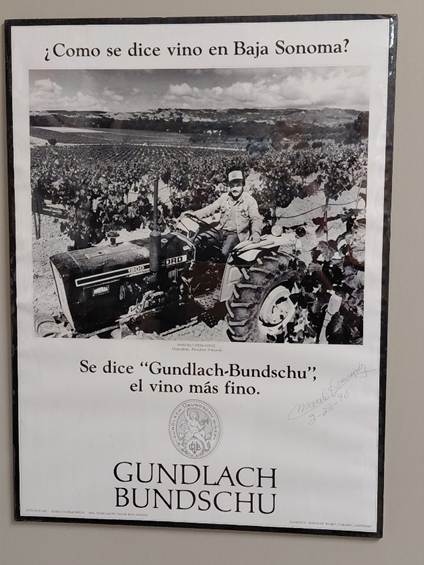
“Como se dice vino en Baja Sonoma?” is one of my favorite posters. I always felt it was critical that we remind people of the incredible contribution Mexicanos made to the success of the California wine boom. I worked alongside Marcelo Hernandez my first Crush in 1978. He taught me the ropes, trained me to operate the equipment, and laughed at my jokes. He bestowed upon me one of the greatest compliments I have ever received when he told me, “Lance, you work like a Mexican.” We worked together in the winery for just that one harvest. The next year Jim Bundschu promoted him to Vineyard manager, a position he kept for more than 20 years.
We believe this to be the first Spanish language advertisement in the California wine business. It features Marcelo sitting on his tractor in the midst of Rhinefarm Vineyards. We set up to do this shoot on three different days before we actually shot photos, because Ron Zak insisted we wait for an afternoon with clouds on the horizon. It was worth the wait. Always trust the artist. Marcelo was understandably proud of starring in this photo.
Marcelo was able to purchase property about a mile from Rhinefarm. He planted two acres of merlot grapes and did all the work on the vineyard from disking, pruning, and harvesting the grapes. Wind blowing through a row of Eucalyptus trees to the west of his property seemed to flavor the grapes with a distinctive minty character. For years, I made small batches of wine from Marcelo’s grapes for my home brand called Guerrilla Vino. When Rusty Staub, the famous baseball player and my longtime friend, enticed me to make wine for him to help raise money for his various charities, we launched Relentless Wines using those unique merlot grapes from Marcelo’s Vineyard.
Marcelo passed earlier this year.
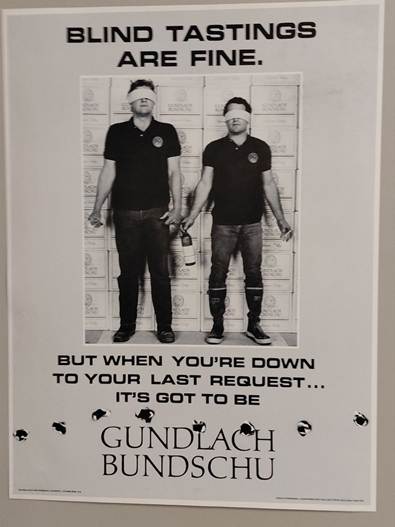
McCullough insisted it was time for Bundschu and I to appear in a poster. I stacked a bunch of Gundlach Bundschu cases until we had a wall seven feet high to serve as a backdrop. We shot dozens of photos with Jim and I toasting one another. I had the idea of “blind tastings and your last request,” so we shot a few photos of us in blindfolds. After looking at the photos, Jim decided to go conservative. He chose a simple photo of the two of us sitting on Gundlach Bundschu cases toasting one another. We even printed those posters, which I thought were boring.
I enlisted Ron Zak and Chuck House to help me produce the “Blind Tastings” poster. Chuck did a brilliant job with the bullet holes. I paid for the poster production myself. At the bottom we added, “Unauthorized, Unapproved Collector’s Edition.” Once I had the posters in hand, we passed them out letting people know that Bundschu was unaware of their existence and enlisting recipients to keep the secret as long as possible. If my recollection serves, we were able to go two months before the secret got out, making the poster a true collector’s treasure.