A boom of fine dining restaurants coincided with the explosion of interest concerning California wine. Chefs who had immigrated from Europe were opening fancy restaurants without liquor licenses. Their customers back home were happy just drinking wine with their meals, they figured Americans should be content as well. There was no need to provide alcoholic cocktails and pay the exorbitant license fees for hard liquor. These restaurants provided a great untapped market for California wines, and our posters had helped us get entrenched on restaurant wine lists.
Distributors across the country who had focused on hard liquor sales realized that wine was a growing market. To risk being left at the station in the face of a wine boom, they had to bring California wine into their portfolios, train their salespeople, and reap the benefits of wine’s growing popularity. Distributors would come to Wine Country with their entire sales staff, visit wineries that they represented, and make pitches to new wineries they hoped to bring into the fold.
The sales teams would arrive at a winery, listen to a speech from a principal or owner and then suffer through an elaborate tasting of the winery’s entire lineup of wines. Since more than 70 percent of the salespeople were long-time hard liquor salesmen and had no interest in selling wine, they were often inattentive and bored out of their skulls. They sold established liquor brands, and the flavor of those brands never changed.
A sales staff visiting Gundlach Bundschu discovered a very informal affair. Music would be blasting, and giant Weber barbecues would cook delicious sausages from Sonoma Sausage Factory. Both red and white wine would be poured, but ice chests filled with local micro brews dotted the premises. We’d explain, “It takes a lot of good beer to make great wine.” McCullough was convinced that liquor salespeople were dinosaurs and would be of no help to us. He taught us to recognize the few salespeople interested in wine. The concept of learning grape varieties, vintage differences, and the varying flavors imparted by the different barrels used fascinated them.
The more information we gave them, the more rivetted they became. Instead of boring formal tastings, we herded them into our cave and let them taste directly from the barrels. We’d put them on the bottling line, show them how to operate the press, and let them help clean the lees filter. During harvest we’d drag them into the vineyard, hand them grape harvesting knives and let them pick grapes. They loved it. They related to our humorous approach, saw we were different from most other wineries, and they became our ambassadors into the markets across America.
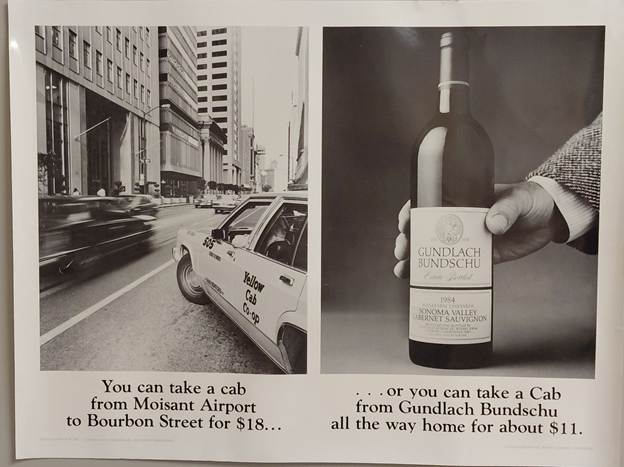
We decided to pay tribute to the salespeople doing the best job selling our wine. We also felt the time was right to enter the Cabernet Sauvignon fray. We created a two-shot poster showing a taxi on a busy, generic downtown street next to a hand holding a bottle of Gundlach Bundschu Cabernet Sauvignon. We did eight different posters for eight separate cities. The photos remained the same, but the captions changed. You can take a cab from Moisant Airport to the French Quarter became a cab from Sea Tac to the Space Needle or a cab from Logan Airport to Faneuil Hall. Take a Gundlach Bundschu Cab all the way home really resonated, especially for just $11, and the locals respected that we knew the iconic destinations of each city.
McCullough worked the markets tirelessly. He insisted that Bundschu and I help him by visiting various markets. “They could care less about the sales manager,” he said. “They want to spend time with the owner and winemaker.” Bundschu was more reluctant, but I discovered I loved visiting people and working the markets, and I was good at it. Over time, we had identified key salespeople in every market. Visiting them on their home territory, working with them in their accounts, and having them visit us in Sonoma forged dynamic friendships.
We felt that we were part of a secret adjunct of the wine business, one of quality, value, fun and good humor. Our key wine salespeople became good friends. We spent lots of time together, created the Wine Patrol trips to thank them, and encouraged them to participate in our sales and marketing whenever they could. Ron Paradise was our key salesperson in Kansas City, Missouri. He’d take us to the best barbecue restaurants, introduce us to legendary jazz locations, and get us tickets for baseball games. One day, while at a Kansas City Royals game, he came up with the line, “If you pour it, they will come.”
Returning home, I contacted the Oakland A’s seeking permission to take a photo of their stadium for our poster. They denied the request. We sent Ron Zak to the Oakland stadium to take a photo anyway, but either Ron was nervous about not having permission, or didn’t understand baseball. We felt none of the photos would work for a poster.
I rented a camera equipped with an 180 degree lens aperture. The camera was noisy and heavy. You’d click the button to take a picture, and the shutter would swing across the lens in an arc. McCullough and I went to Oakland Stadium early for batting practice. I found it was impossible to keep the camera steady throughout the entire shot. Finally, I rested the camera on a short concrete wall above an exit stairway. It gave us a steady platform to get the picture.
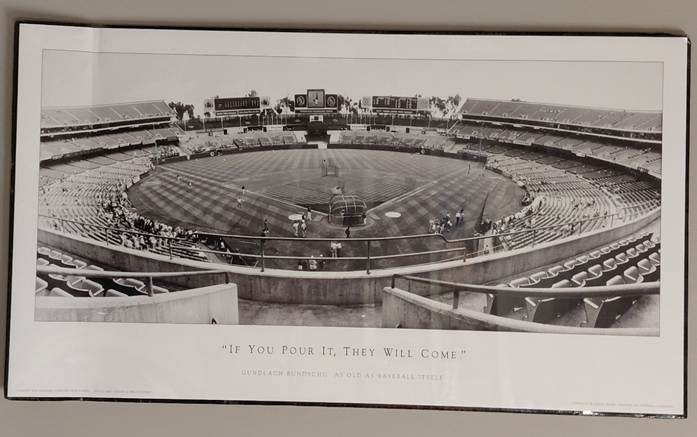
Once we had the photo, we turned it over to Chuck House. He really went to town on it. The center field scoreboard has a picture of a bottle of Gundlach Bundschu wine flanked by Bundschu logos and a Gundlach Bundschu banner on the bottom. The scoreboard to the right is bracketed by Cutler Cellar logos with a banner showing “gun, lock, bun, shoe.” The scoreboard to the left touts Sonoma Valley Vineyards, where great wines are born. Sonoma Valley Wine Patrol logos flank the score which shows Vineburg beating St. Helena 8 to 0. All the advertising signs have been reimagined. The more you look the more you see.
At the bottom, we credit Ron Paradise with the concept, attributing it to Cow Town Wine Patrol. Because we had been denied permission to use the image, McCullough and I used pseudonyms of Diego Sonoma and Jake Lorenzo on the photo credit. Finally, McCullough came up with the classic line, “Gundlach Bundschu. As old as baseball itself.”
Months later, we were contacted by a couple of Oakland A’s players. They had seen the poster and loved it. They sent free tickets to a game and asked us to bring copies of the poster. We got there early, went to the club house, gave them a stack of posters and left with a pile of A’s gear. Never had any repercussions from Oakland Stadium for using an unauthorized photo.
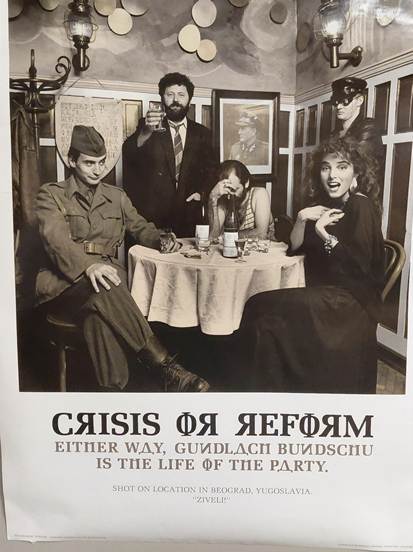
We felt bad about not using Ron Zak’s photos for the baseball poster. We were able to make it up to him with our next project. Ron landed some sort of mentorship in Yugoslavia teaching photography. He told us the whole time he was in Yugoslavia, he couldn’t stop thinking of ideas for posters. He came back with a terrific photo which we turned into the “Crisis or Reform” poster. All the models in the poster were students in Ron’s class.
Chuck House made things entertaining and interesting with a really unique font, letters turned backwards and a lightly colored sepia ink printing lending the whole photo a dusty Eastern European sensibility. “Either way Gundlach Bundschu is the life of the party.”
Once again, I am reminded how long ago this all happened. Yugoslavia is no longer a country. Moisant Airport is gone from New Orleans, replaced by Louis Armstrong International Airport. Ron Paradise is no longer with us. The baseball stadium is deserted and the A’s play in Sacramento at a minor league park on their way to Las Vegas. And $11 Cabernet . . . come on.
It’s enough to make you drink. At least I have a cellar full of good wine.
