Jim McCullough had this great idea to create posters that would teach people how to pronounce Gundlach Bundschu. The thing was, none of us had a clue how to produce a poster, so they gave the production task to me. My wife is a weaver, and she was in the Sonoma Arts Guild. I knew the Guild had photographers as members. I asked some of the artists and they recommended Bob Nixon. Nixon’s forte was landscape photos, but he listened as I explained that we needed something that showed the words “gun, lock, bun and shoe.” Even though it was not his primary focus, he said he’d give it a shot.
I contacted him every few days to see if he was making progress. He got a little pissed and said I should stop bothering him. He’d let me know when he had a photo to show me. I hadn’t heard from him for a couple of weeks, when he finally called and said he had something for me to look at. He had composed a scene with a bottle of Gundlach Bundschu wine, a clown doll holding our logo, a couple glasses of wine and children’s alphabet blocks spelling out the words. It did the job. He had come up with the entire thing on his own and didn’t seem keen on collaboration.
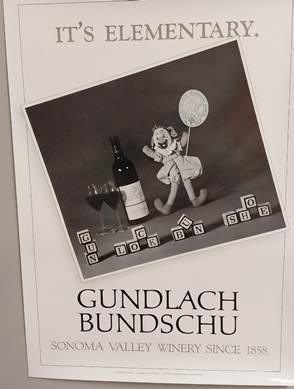
I had him make a print so I could show it to McCullough and Bundschu. They thought the picture was well composed and clearly showed the four words to pronounce the winery, so we moved forward with the project. We had already decided on black and white production to keep the cost down. We kept the poster simple. It read, “It’s elementary,” at the top, with the name of the winery below the picture stacked as it appears on the label. We added “Sonoma Valley Winery” so they’d know where we were and we added “since 1858” for historical perspective.
I took the photo to Chuck House, told him what we wanted to say on the poster. I asked if he could work on it and then suggest a printer. Typical of Chuck, he brilliantly chose to angle the photo having the corners of the photo break through the border line of the poster. It made it look as if the photo were lying on top of the poster and it heightened the sense of whimsy. He chose the fonts, and the whole thing came together.
Chuck suggested a printer, worked out the production details, and got a run date. Chuck insisted that I accompany him to the print run. That’s when I saw how great Chuck House was. He spoke to the press operator in his own language. They’d print a poster, look at it, talk about it, and then tweak the black or punch up the greys. Finally, when Chuck thought it was perfect, we printed the run.
Whenever one of us went on the road to work a market, we’d send several dozen posters ahead of our arrival. Once there, we’d take them with us on account calls. We gave them away free to salespeople and to any accounts that purchased Gundlach Bundschu wines for their stores or restaurants. The response to the poster was extraordinary. People found them amusing and playful, a distinct counterpoint to the overly serious attitude adopted by most of the wine industry. The poster also did its job extremely well: it taught people how to pronounce our name. We saw sales increase everywhere we introduced the posters.
We ran through our supply of that first poster in just a few months. Instead of reprinting, McCullough suggested we do a new poster. Back when I worked as a cellar rat, people would ask how I got into the wine business. I’d tell them, “I used to be a schoolteacher. Teaching got me into drinking, and drinking led to the wine business.” Using that as a theme, we created a poster featuring a school Marm. Bundschu suggested we invite Susie Scarborough to be the star. Susie was a neighbor, originally from Texas, who worked as a stewardess. She was personable, fun and in the local vernacular, “A real hoot.” She agreed.
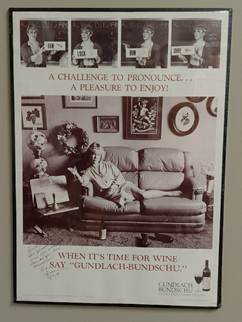
I reached out to Bob Nixon again, told him our new idea, and he agreed to shoot the photos. This time we took four separate photos with Susie as a teacher in front of a blackboard holding flashcards showing how to pronounce the winery’s name. Ever meticulous, Nixon’s attention to detail was incredible; Susie put her hair up into a bun, donned glasses, a sweater over a simple blouse. Each flash card had a word printed on it along with an illustration. The blackboard even had the alphabet listed in both upper and lower case letters. Underneath the photos, again teasing the difficulty pronouncing our name, we printed “A challenge to pronounce . . . a pleasure to enjoy.”
The plan was to then shift to a big shot of Susie, the school Marm, transformed into a beautiful woman letting her hair down with a glass of wine. Unfortunately, after shooting the first four photos, Bob Nixon decided this was not photography he enjoyed doing. He suggested we contact another photographer named Ron Zak to shoot the final picture. Bob Nixon was an accomplished photographer. He was introspective and serious about his photography. He preferred working alone. He questioned whether doing commercial work for a winery might diminish the real focus of his art.
Ron Zak was completely different. He was high energy, boisterous and continually animated. For Ron, the more people involved the merrier. He was also an exceptionally talented photographer. We brought him in for the photoshoot. The set was elaborate. We had an antique school desk with a school bell, a vintage lamp, and flowers. Susie’s hair was down, her glasses and shoes off, and she was in a sensuous pose. On the wall behind her were reminders of Gundlach Bundschu’s historical importance, ancient posters, family portraits of the founders, and historic paintings. The caption read, “When it’s time for wine . . . say Gundlach Bundschu.”
There were loads of elements in this poster. Four shots depicting the four words and the master shot full of clues and historical elements. Chuck House felt the best idea was to be straightforward and let the amazing background details in the photos slowly draw in the viewer. Because there was an old-time, old world feel to the photos. He suggested we print in sepia tones, which were no more expensive than black and white, but created a much different feel.
Once again, we took the posters out into the market. They were a hit. In a time when fine wine was serious business, here was a very historical winery having fun, and they had a sense of humor. People were intrigued by our lighthearted approach. They were learning how to pronounce the name of our winery. Once a person learned pronunciation, they’d teach it to others. Attracted by the humor, learning to say the name, they’d taste the wines and discover they were delicious, especially for the price.
Not only that, but this was an underground exercise. We had decided not to publicize the posters until we saw the response they generated. Only people in the business, wine salespeople, waiters, and buyers for stores and restaurants and had seen the posters. These were the real movers and shakers of the wine business. Sales were increasing. Gundlach Bundschu was becoming hip.
I started at Gundlach Bundschu running their tasting room. The tasting room was only open on Saturdays and Sundays from 12 to 4 PM., and I was the only employee. One of our first white wine releases was Gewürztraminer. It was hard enough teaching people how to pronounce the winery’s name. Throw Gewürztraminer into the mix and you’ve got a real problem. I would tell tourists that if Sonoma Valley police stopped them, they could simply say, “Gundlach Bundschu Gewüztraminer,” and the cops would let them go.
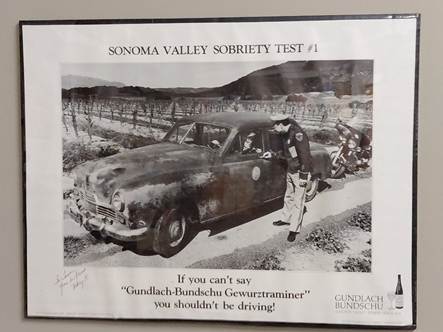
After two posters teaching people how to pronounce our name, we decided it was time to go all in on our humor campaign. For years, Jim Bundschu had been storing an old Kaiser automobile in the barn. It was rusting with fading paint. We dragged the car out to the road leading through our Rhinefarm Vineyard. We got a local, retired CHP officer to put on his uniform and show up on a motorcycle. He even brought a ticket book. In an inspired bit of casting, McCullough, Bundschu and I were able to convince Jim’s mom, Mary Bundschu, to be behind the wheel. Zak captured the shot perfectly.
SONOMA VALLEY SOBRIETY TEST #1
If you can’t say
Gundlach Bundschu Gewürztraminer
you shouldn’t be driving!
The poster was a huge hit. Everybody loved it. Local people clamored for copies. Restaurants and wine shops hung it on their walls. Reporters would see it and show up to write stories about the winery poking fun at the staid fine wine business. We reprinted the poster multiple times. We were off and running.
Over the next ten years, we produced almost two dozen Gundlach Bundschu (and Cutler Cellar) posters. Each one related to something important and true to our winemaking experience. All the featured models were local people happy to help us out. In a time when full color advertising was in vogue, our black and white posters were deemed imaginative and artistic. The release of a new poster was a cause for celebration.
Somehow, in the 30 plus years since the last Gundlach Bundschu poster, the posters and their importance to Wine Country history have been forgotten. For the most part, they were produced and circulated before cell phones and the internet, so they are hard to find. The photos comprising the posters were shot on film, using real cameras and required darkroom development and printing.
Working with McCullough and Bundschu, collaborating with artists like Chuck House, Bob Johnson, and Ron Zak, then bringing ideas to life with gifted printers like Dennis Patterson was thrilling. We respected one another and all contributed to make a product that we were proud to claim our own. Compared to the pressure and sometimes drudgery of making wine, the posters were like playtime for me.
Years ago, I had intended to write about the magic of those glory years st Gundlach Bundschu, but life intruded. Years passed. I found I had forgotten many of the details along with the sequence of events, so I pushed it aside, assuming I would never do it.
One of my Cutler Cellar posters sits on the wall next to my desk. I see it every day. Of the eight people in the photo, only two of us are alive. More than half of the local models appearing in the GB posters, the people contributing ideas, and the salespeople who sold our wine have died or retired. Ben Franklin Press, the company that printed our posters, was sold. It occurred to me that someone needed to tell the story, to honor the people who contributed to this special, historic wine industry moment. I don’t know anyone else who can. That’s why I’m trying to do it now.
Wish me luck.

Loved those posters – and the “CHP” poster still resides in the warehouse office at San Antonio Winery in Los Angeles. They’re almost as famous as Bob Johnson’s covers for Pacific Wine Company….
Hi Lance,
Thanks for the info on your new story. I was able to access it through winepatrol.com. Great to hear how those posters came to be. I loved those posters! They were so clever. Bob (my husband) still has a number of them up and framed in his office. And I did know Bob Nixon and Ron Zak. Not personally, but I know of them. Bob Nixon would have his photos displayed in the crafts exhibition hall at the Sonoma Co fair in the ‘80s. I always marveled at them, they were extraordinary. He always got first place ribbons. (That must have been before he went professional) Kids, and probably anyone under 50, have no concept how something like this could be done totally analog, meaning no digital help at all. And done locally without spending mega bucks. You guys really did something special and unique! What a treasure. I’ll tell Bob he better hang on to those posters in the office. I am looking forward to seeing part two of the story.
Mary Sullivan
I love that you’re telling this story and that some of the poster images in this article are signed by people who felt strongly about them and about your efforts to create them. These posters remind me so much of visiting you and the amazing experiences we all had together. Thank you!
A great story! I never saw the posters but somehow the vibe of Gundlach Bundschu being a fun brand made its way to me in Napa.
I especially appreciate recognition of the incredible talent and craft involved.