The Posters (Part 4)

A boom of fine dining restaurants coincided with the explosion of interest concerning California wine. Chefs who had immigrated from Europe were opening fancy restaurants without liquor licenses. Their customers back home were happy just drinking wine with their meals, they figured Americans should be content as well. There was no need to provide alcoholic cocktails and pay the exorbitant license fees for hard liquor. These restaurants provided a great untapped market for California wines, and our posters had helped us get entrenched on restaurant wine lists.

Distributors across the country who had focused on hard liquor sales realized that wine was a growing market. To risk being left at the station in the face of a wine boom, they had to bring California wine into their portfolios, train their salespeople, and reap the benefits of wine’s growing popularity. Distributors would come to Wine Country with their entire sales staff, visit wineries that they represented, and make pitches to new wineries they hoped to bring into the fold.

The sales teams would arrive at a winery, listen to a speech from a principal or owner and then suffer through an elaborate tasting of the winery’s entire lineup of wines. Since more than 70 percent of the salespeople were long-time hard liquor salesmen and had no interest in selling wine, they were often inattentive and bored out of their skulls. They sold established liquor brands, and the flavor of those brands never changed.

A sales staff visiting Gundlach Bundschu discovered a very informal affair. Music would be blasting, and giant Weber barbecues would cook delicious sausages from Sonoma Sausage Factory. Both red and white wine would be poured, but ice chests filled with local micro brews dotted the premises. We’d explain, “It takes a lot of good beer to make great wine.” McCullough was convinced that liquor salespeople were dinosaurs and would be of no help to us. He taught us to recognize the few salespeople interested in wine. The concept of learning grape varieties, vintage differences, and the varying flavors imparted by the different barrels used fascinated them.

The more information we gave them, the more rivetted they became. Instead of boring formal tastings, we herded them into our cave and let them taste directly from the barrels. We’d put them on the bottling line, show them how to operate the press, and let them help clean the lees filter. During harvest we’d drag them into the vineyard, hand them grape harvesting knives and let them pick grapes. They loved it. They related to our humorous approach, saw we were different from most other wineries, and they became our ambassadors into the markets across America.

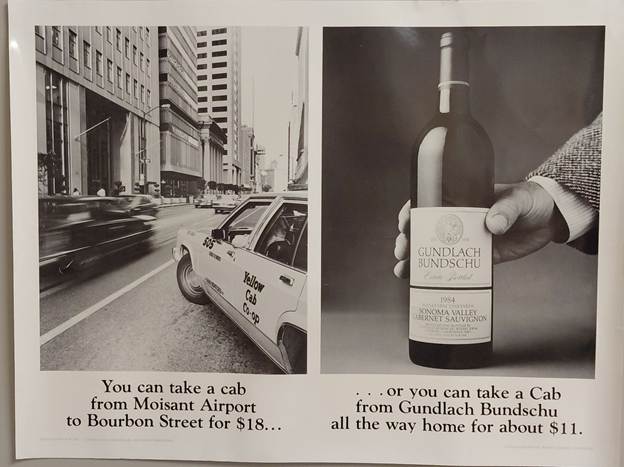
We decided to pay tribute to the salespeople doing the best job selling our wine. We also felt the time was right to enter the Cabernet Sauvignon fray. We created a two-shot poster showing a taxi on a busy, generic downtown street next to a hand holding a bottle of Gundlach Bundschu Cabernet Sauvignon. We did eight different posters for eight separate cities. The photos remained the same, but the captions changed. You can take a cab from Moisant Airport to the French Quarter became a cab from Sea Tac to the Space Needle or a cab from Logan Airport to Faneuil Hall. Take a Gundlach Bundschu Cab all the way home really resonated, especially for just $11, and the locals respected that we knew the iconic destinations of each city.
McCullough worked the markets tirelessly. He insisted that Bundschu and I help him by visiting various markets. “They could care less about the sales manager,” he said. “They want to spend time with the owner and winemaker.” Bundschu was more reluctant, but I discovered I loved visiting people and working the markets, and I was good at it. Over time, we had identified key salespeople in every market. Visiting them on their home territory, working with them in their accounts, and having them visit us in Sonoma forged dynamic friendships.

We felt that we were part of a secret adjunct of the wine business, one of quality, value, fun and good humor. Our key wine salespeople became good friends. We spent lots of time together, created the Wine Patrol trips to thank them, and encouraged them to participate in our sales and marketing whenever they could. Ron Paradise was our key salesperson in Kansas City, Missouri. He’d take us to the best barbecue restaurants, introduce us to legendary jazz locations, and get us tickets for baseball games. One day, while at a Kansas City Royals game, he came up with the line, “If you pour it, they will come.”

Returning home, I contacted the Oakland A’s seeking permission to take a photo of their stadium for our poster. They denied the request. We sent Ron Zak to the Oakland stadium to take a photo anyway, but either Ron was nervous about not having permission, or didn’t understand baseball. We felt none of the photos would work for a poster.

I rented a camera equipped with an 180 degree lens aperture. The camera was noisy and heavy. You’d click the button to take a picture, and the shutter would swing across the lens in an arc. McCullough and I went to Oakland Stadium early for batting practice. I found it was impossible to keep the camera steady throughout the entire shot. Finally, I rested the camera on a short concrete wall above an exit stairway. It gave us a steady platform to get the picture.
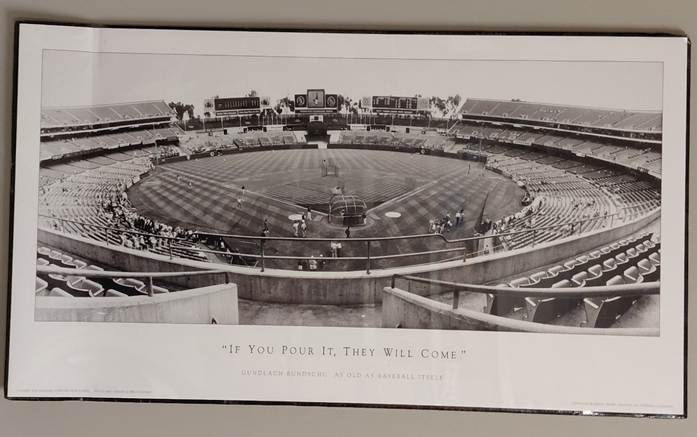
Once we had the photo, we turned it over to Chuck House. He really went to town on it. The center field scoreboard has a picture of a bottle of Gundlach Bundschu wine flanked by Bundschu logos and a Gundlach Bundschu banner on the bottom. The scoreboard to the right is bracketed by Cutler Cellar logos with a banner showing “gun, lock, bun, shoe.” The scoreboard to the left touts Sonoma Valley Vineyards, where great wines are born. Sonoma Valley Wine Patrol logos flank the score which shows Vineburg beating St. Helena 8 to 0. All the advertising signs have been reimagined. The more you look the more you see.

At the bottom, we credit Ron Paradise with the concept, attributing it to Cow Town Wine Patrol. Because we had been denied permission to use the image, McCullough and I used pseudonyms of Diego Sonoma and Jake Lorenzo on the photo credit. Finally, McCullough came up with the classic line, “Gundlach Bundschu. As old as baseball itself.”

Months later, we were contacted by a couple of Oakland A’s players. They had seen the poster and loved it. They sent free tickets to a game and asked us to bring copies of the poster. We got there early, went to the club house, gave them a stack of posters and left with a pile of A’s gear. Never had any repercussions from Oakland Stadium for using an unauthorized photo.
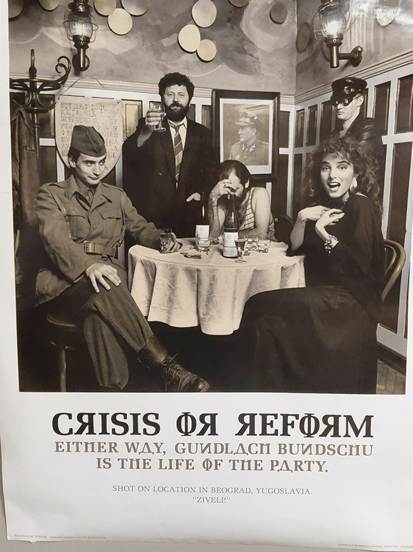
We felt bad about not using Ron Zak’s photos for the baseball poster. We were able to make it up to him with our next project. Ron landed some sort of mentorship in Yugoslavia teaching photography. He told us the whole time he was in Yugoslavia, he couldn’t stop thinking of ideas for posters. He came back with a terrific photo which we turned into the “Crisis or Reform” poster. All the models in the poster were students in Ron’s class.

Chuck House made things entertaining and interesting with a really unique font, letters turned backwards and a lightly colored sepia ink printing lending the whole photo a dusty Eastern European sensibility. “Either way Gundlach Bundschu is the life of the party.”

Once again, I am reminded how long ago this all happened. Yugoslavia is no longer a country. Moisant Airport is gone from New Orleans, replaced by Louis Armstrong International Airport. Ron Paradise is no longer with us. The baseball stadium is deserted and the A’s play in Sacramento at a minor league park on their way to Las Vegas. And $11 Cabernet . . . come on.

It’s enough to make you drink. At least I have a cellar full of good wine.
The Posters (Part 3)

In the 1980s and 90s the wine boom was driven primarily by two varietals: cabernet sauvignon and chardonnay. Retail stores would often carry other varietals, but restaurants focused on cabernet and chardonnay. McCullough insisted that placements on restaurant wine lists were the key to success. Having your wine on a wine list gave your wine that verifiable third party endorsement guaranteeing the wine was good and worthy of the customer’s attention. The problem was that almost every winery in California was fighting to place their cabernet and chardonnay on those lists. The competition was intense, and if you got your wine placed, it would appear among a lengthy list of wineries.

McCullough reasoned that if we could place alternative red and white wines on restaurant wine lists, there would be less competition, and our wines would stand out. The poster series had taught people, especially waiters and wine salespeople, to pronounce our winery’s name. We figured if we could get wines on wine lists, waiters would happily sell them. We opted to focus on merlot as our red wine.

Merlot was an easy drinking red wine, more easily accessible than cabernet because it had less tannin. Most merlot producers blended cabernet into their merlot just to add some tannic backbone. Rhinefarm merlot was unique, because it had plenty of tannin, which gave the wine added weight and a long finish. Instead of blending with cabernet sauvignon, we’d mix different blocks of grapes from within the Rhinefarm to achieve more complexity while still producing a wine that was 100 percent merlot.

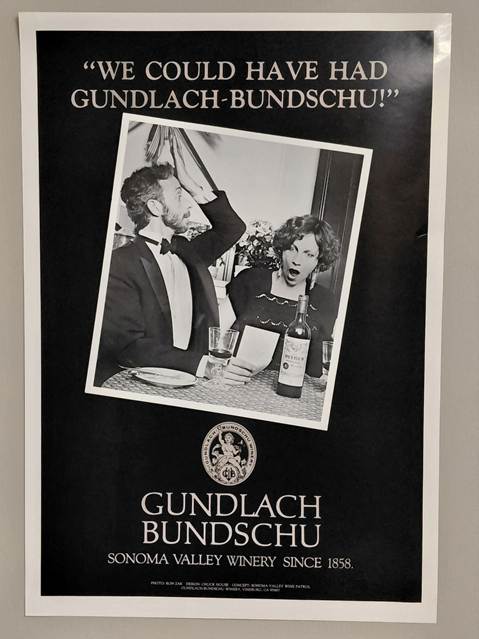
We needed a poster to launch our assault for space on restaurant wine lists. We decided to feature Chateau Petrus, arguably the most famous merlot in the world. An elegantly dressed couple has just been presented with the bill at the end of their meal. They are shocked at the price. “We could have had Gundlach Bundschu!” The poster aligned our wine with the finest merlot in the world and then emphasized that it was a bargain for similar quality.

James Patrick plays the gentleman. James wanted to learn about winemaking and would often come to the winery to help me with late night press loads. Kristin Anneker is his date. Kristin had dreams of making costumes for Hollywood movies. She created and produced the black velvet capes we all wore when we hijacked the Napa Valley Wine Train, and she ended up in Hollywood working as a successful costume designer for years.

Gundlach Bundschu Merlot found its way onto hundreds of wine lists. Often, the only other merlot offered on the list was from Duckhorn Vineyards, and the two of us became recognized as the two finest producers of merlot in California.

The merlot assault for space on wine lists was a tremendous success. We needed a white wine as well. Gundlach Bundschu was one of the few wineries to produce gewürztraminer, and most of the other producers made their wine sweet. Ours was bone dry, which made it a worthy compliment to all kinds of food. gewürztraminer is a strange grape to grow. The clusters tend to bunch up around the center of the vine making it hard to harvest. As the grapes ripen, the skins turn pink, and all at once (around 21 to 22° Brix) the acid drops out of the grapes overnight. We’d pick at those low sugars (something no one else was doing in those days) to retain what acidity we could. The resulting wine was clean and crisp with sparkling aromas of lychee and spice.

Maybe we were a bit cocky and overconfident, but we were on a roll. We decided to make gewürztraminer our white wine entrée to restaurant wine lists. We reprinted more of the Sobriety Test posters and took them with us when we called upon restaurant buyers. Our restaurant calls were unusual to say the least. We’d walk in with our local sales rep, get introduced to the wine buyer and bring out our bottles of merlot and gewürztraminer. Since almost every other wine rep was trying to place cabernet and chardonnay, we stood out from the crowd immediately.

We’d taste the wines and buyers would immediately relate to the quality of the merlot, but they’d also be stunned by the versatility of our dry gewürztraminer. When possible, I’d have them bring something from their menu and have them taste it paired with the gewürtz. The smoked soft shell crab at Christian’s Restaurant in New Orleans was the perfect pairing, so much so that at least four restaurant reviewers mentioned the pairing when writing about the restaurant.

It was an amazing thing to be sitting in a restaurant and hear a table burst into laughter when the waiter told them, “If you can’t say Gundlach Bundschu Gewürztraminer, you shouldn’t be driving.” In New Orleans, we hosted our first Waitstaff Ball on a Thursday night. The free event, exclusively for waiters, started at 10 PM, after dinner service. We had chefs from around town cook food, Charmaine Neville’s Band played, Gundlach Bundschu wines were served, and 300 waiters attended. The Waitstaff Ball ignited sales of Gundlach Bundschu in New Orleans. Mr. B’s restaurant sold three cases of Gewürztraminer the following weekend alone. Our sales soared from a respectable 1,000 cases a year to 3,000 cases per year, and they stayed there for seven years.

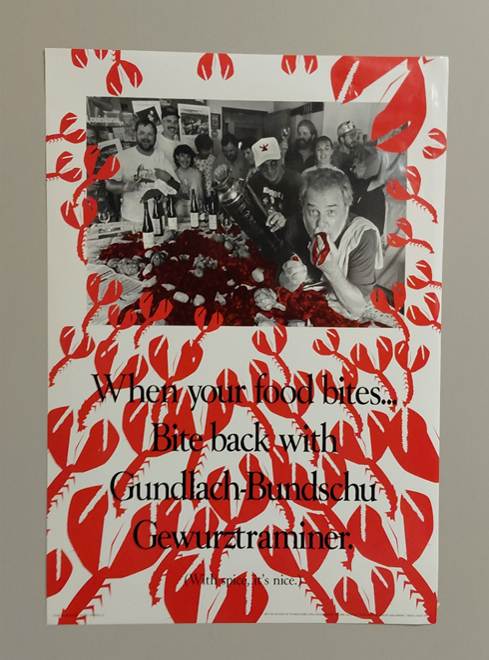
As a reward for our success with gewürztraminer on restaurant wine lists and to thank our New Orleans friends for their unwavering support, we created a second poster for gewürtz. We show our New Orleans friends at a crawfish boil, “When your food bites . . . Bite Back.” The scene is in Jerry and Catherine Henry’s garage. Depicted guests include family members, restaurant owners, and even two wine salesmen from a rival company. Chuck House came up with the idea of adding crawfish he had drawn all over the poster and using red for some color emphasis, making this unique among the entire poster series.

Once we had a foothold on restaurant wine lists with our merlot and gewürztraminer, and restaurant customers were buying the wines consistently, it became much easier to get those restaurants to add our other wines to their list. Gundlach Bundschu became synonymous with excellent, good value Merlot. Our merlot was so popular that we had to put it on allocation to protect our wine list placements.

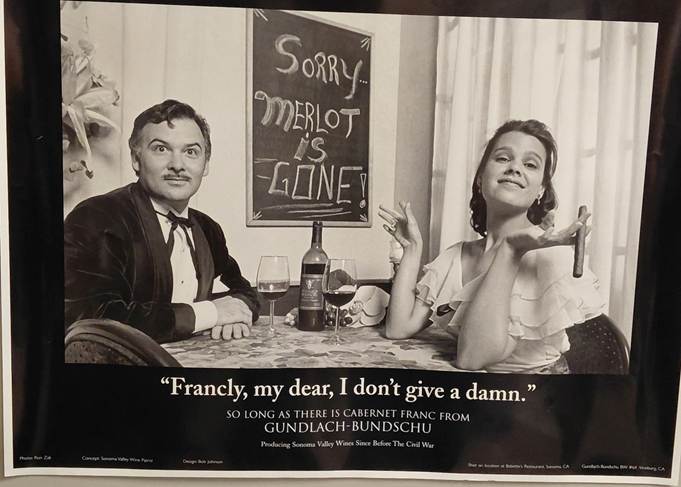
We wanted to bring another red wine to the game. Cabernet franc was one of the newer plantings on Rhinefarm. I had hoped it would add some complexity to our cabernet sauvignon while taming the tannins. Instead, we found we had a very tannic cabernet franc. Still wary of entering the overly competitive cabernet sauvignon fray, we went with cab franc. The firm tannic backbone provided by the soils of Rhinefarm, made Gundlach Bundschu Cabernet Franc a delicious alternative.

A waiter and waitress from the extremely popular Piatti’s restaurant in Sonoma agreed to be our models. Poking fun at our precarious merlot supply, we riffed off a Gone with the Wind line, “Francly, my dear, I don’t give a damn.” Unique to this poster is the newly revamped Gundlach Bundschu label adorning the bottle. McCullough and I loved this new label, but the Bundschu family decided to return to the more staid old format.

The Posters (Part 2)

The poster program turned out to be an unqualified success. Our first two posters focused on teaching people how to pronounce the name of our winery. The third threw down the gauntlet declaring we were serious about making wine but had a sense of humor about it. We discussed how to continue with the series and decided we should introduce some of the key players.

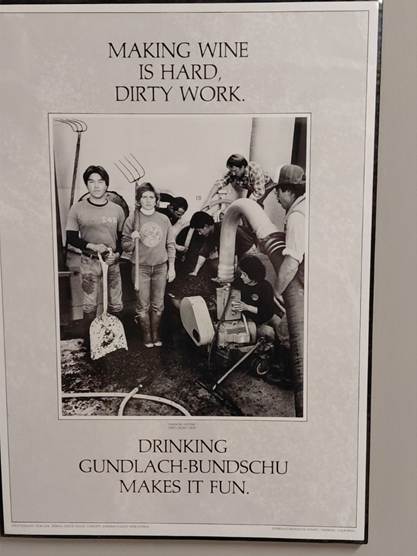
Using Grant Wood’s American Gothic as an inspiration, we introduced the entire 1985 Gundlach Bundschu winemaking crew posed around a tank and in the process of shoveling fermented grape must to the press. We are using a Ministrine peristaltic pump. This thing had an augur in the back which would feed must into the pump and then force it through the ridiculously oversized six-inch hose all the way to the press. It was critical to keep enough wine dribbling into the must to keep it from plugging the hose.

We captioned the photo “Vineburg Gothic, 1985 Crush Crew.” Marcelo Hernandez Jr. holds the shovel. His father was our vineyard manager. Holding the bent pitchfork, is Jane Leach (now Milligan) who had come to America from England. She helped Ann Noble create the Wine Aroma Wheel while studying at UC Davis. She went on to head sensory and experimental wine production at Beringer Winery, before returning to England and marrying her high school sweetheart. Jerry Chong is scooping grapes with his hand into the hopper. Jerry left winemaking for vineyard management. Katie Quinn is operating the on/off buttons. She married Ben Zeitman and together they ran Amador Foothill Winery where she served as winemaker/partner. They retired from the wine business after selling the winery in 2014. Jim Farnkopf, our Cellar Master, is holding the hose dripping wine back into the pump. Bill (whose last name I cannot remember, even after years of working together, which I find frightening) is holding the black pump hose, and my head is sticking through the tank door. Sadly, Marcelo Hernandez Jr. and Jim Farnkopf are no longer with us.

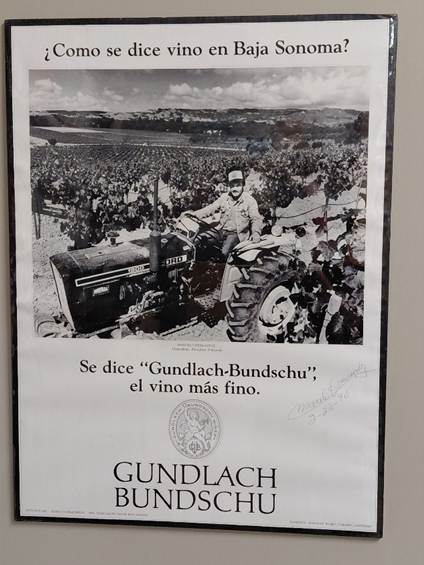
“Como se dice vino en Baja Sonoma?” is one of my favorite posters. I always felt it was critical that we remind people of the incredible contribution Mexicanos made to the success of the California wine boom. I worked alongside Marcelo Hernandez my first Crush in 1978. He taught me the ropes, trained me to operate the equipment, and laughed at my jokes. He bestowed upon me one of the greatest compliments I have ever received when he told me, “Lance, you work like a Mexican.” We worked together in the winery for just that one harvest. The next year Jim Bundschu promoted him to Vineyard manager, a position he kept for more than 20 years.

We believe this to be the first Spanish language advertisement in the California wine business. It features Marcelo sitting on his tractor in the midst of Rhinefarm Vineyards. We set up to do this shoot on three different days before we actually shot photos, because Ron Zak insisted we wait for an afternoon with clouds on the horizon. It was worth the wait. Always trust the artist. Marcelo was understandably proud of starring in this photo.

Marcelo was able to purchase property about a mile from Rhinefarm. He planted two acres of merlot grapes and did all the work on the vineyard from disking, pruning, and harvesting the grapes. Wind blowing through a row of Eucalyptus trees to the west of his property seemed to flavor the grapes with a distinctive minty character. For years, I made small batches of wine from Marcelo’s grapes for my home brand called Guerrilla Vino. When Rusty Staub, the famous baseball player and my longtime friend, enticed me to make wine for him to help raise money for his various charities, we launched Relentless Wines using those unique merlot grapes from Marcelo’s Vineyard.

Marcelo passed earlier this year.

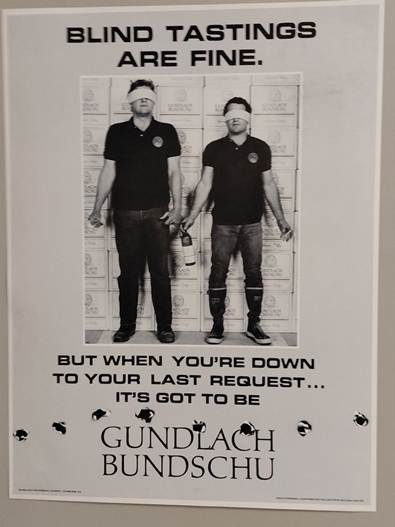
McCullough insisted it was time for Bundschu and I to appear in a poster. I stacked a bunch of Gundlach Bundschu cases until we had a wall seven feet high to serve as a backdrop. We shot dozens of photos with Jim and I toasting one another. I had the idea of “blind tastings and your last request,” so we shot a few photos of us in blindfolds. After looking at the photos, Jim decided to go conservative. He chose a simple photo of the two of us sitting on Gundlach Bundschu cases toasting one another. We even printed those posters, which I thought were boring.

I enlisted Ron Zak and Chuck House to help me produce the “Blind Tastings” poster. Chuck did a brilliant job with the bullet holes. I paid for the poster production myself. At the bottom we added, “Unauthorized, Unapproved Collector’s Edition.” Once I had the posters in hand, we passed them out letting people know that Bundschu was unaware of their existence and enlisting recipients to keep the secret as long as possible. If my recollection serves, we were able to go two months before the secret got out, making the poster a true collector’s treasure.

The Posters (Part 1)

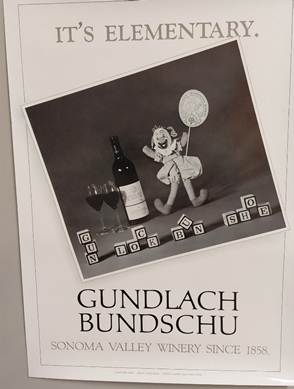
Jim McCullough had this great idea to create posters that would teach people how to pronounce Gundlach Bundschu. The thing was, none of us had a clue how to produce a poster, so they gave the production task to me. My wife is a weaver, and she was in the Sonoma Arts Guild. I knew the Guild had photographers as members. I asked some of the artists and they recommended Bob Nixon. Nixon’s forte was landscape photos, but he listened as I explained that we needed something that showed the words “gun, lock, bun and shoe.” Even though it was not his primary focus, he said he’d give it a shot.

I contacted him every few days to see if he was making progress. He got a little pissed and said I should stop bothering him. He’d let me know when he had a photo to show me. I hadn’t heard from him for a couple of weeks, when he finally called and said he had something for me to look at. He had composed a scene with a bottle of Gundlach Bundschu wine, a clown doll holding our logo, a couple glasses of wine and children’s alphabet blocks spelling out the words. It did the job. He had come up with the entire thing on his own and didn’t seem keen on collaboration.

I had him make a print so I could show it to McCullough and Bundschu. They thought the picture was well composed and clearly showed the four words to pronounce the winery, so we moved forward with the project. We had already decided on black and white production to keep the cost down. We kept the poster simple. It read, “It’s elementary,” at the top, with the name of the winery below the picture stacked as it appears on the label. We added “Sonoma Valley Winery” so they’d know where we were and we added “since 1858” for historical perspective.

I took the photo to Chuck House, told him what we wanted to say on the poster. I asked if he could work on it and then suggest a printer. Typical of Chuck, he brilliantly chose to angle the photo having the corners of the photo break through the border line of the poster. It made it look as if the photo were lying on top of the poster and it heightened the sense of whimsy. He chose the fonts, and the whole thing came together.

Chuck suggested a printer, worked out the production details, and got a run date. Chuck insisted that I accompany him to the print run. That’s when I saw how great Chuck House was. He spoke to the press operator in his own language. They’d print a poster, look at it, talk about it, and then tweak the black or punch up the greys. Finally, when Chuck thought it was perfect, we printed the run.

Whenever one of us went on the road to work a market, we’d send several dozen posters ahead of our arrival. Once there, we’d take them with us on account calls. We gave them away free to salespeople and to any accounts that purchased Gundlach Bundschu wines for their stores or restaurants. The response to the poster was extraordinary. People found them amusing and playful, a distinct counterpoint to the overly serious attitude adopted by most of the wine industry. The poster also did its job extremely well: it taught people how to pronounce our name. We saw sales increase everywhere we introduced the posters.

We ran through our supply of that first poster in just a few months. Instead of reprinting, McCullough suggested we do a new poster. Back when I worked as a cellar rat, people would ask how I got into the wine business. I’d tell them, “I used to be a schoolteacher. Teaching got me into drinking, and drinking led to the wine business.” Using that as a theme, we created a poster featuring a school Marm. Bundschu suggested we invite Susie Scarborough to be the star. Susie was a neighbor, originally from Texas, who worked as a stewardess. She was personable, fun and in the local vernacular, “A real hoot.” She agreed.

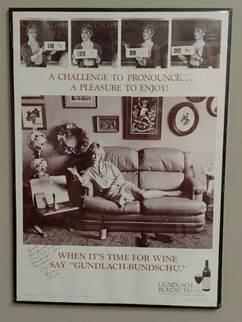
I reached out to Bob Nixon again, told him our new idea, and he agreed to shoot the photos. This time we took four separate photos with Susie as a teacher in front of a blackboard holding flashcards showing how to pronounce the winery’s name. Ever meticulous, Nixon’s attention to detail was incredible; Susie put her hair up into a bun, donned glasses, a sweater over a simple blouse. Each flash card had a word printed on it along with an illustration. The blackboard even had the alphabet listed in both upper and lower case letters. Underneath the photos, again teasing the difficulty pronouncing our name, we printed “A challenge to pronounce . . . a pleasure to enjoy.”

The plan was to then shift to a big shot of Susie, the school Marm, transformed into a beautiful woman letting her hair down with a glass of wine. Unfortunately, after shooting the first four photos, Bob Nixon decided this was not photography he enjoyed doing. He suggested we contact another photographer named Ron Zak to shoot the final picture. Bob Nixon was an accomplished photographer. He was introspective and serious about his photography. He preferred working alone. He questioned whether doing commercial work for a winery might diminish the real focus of his art.

Ron Zak was completely different. He was high energy, boisterous and continually animated. For Ron, the more people involved the merrier. He was also an exceptionally talented photographer. We brought him in for the photoshoot. The set was elaborate. We had an antique school desk with a school bell, a vintage lamp, and flowers. Susie’s hair was down, her glasses and shoes off, and she was in a sensuous pose. On the wall behind her were reminders of Gundlach Bundschu’s historical importance, ancient posters, family portraits of the founders, and historic paintings. The caption read, “When it’s time for wine . . . say Gundlach Bundschu.”

There were loads of elements in this poster. Four shots depicting the four words and the master shot full of clues and historical elements. Chuck House felt the best idea was to be straightforward and let the amazing background details in the photos slowly draw in the viewer. Because there was an old-time, old world feel to the photos. He suggested we print in sepia tones, which were no more expensive than black and white, but created a much different feel.

Once again, we took the posters out into the market. They were a hit. In a time when fine wine was serious business, here was a very historical winery having fun, and they had a sense of humor. People were intrigued by our lighthearted approach. They were learning how to pronounce the name of our winery. Once a person learned pronunciation, they’d teach it to others. Attracted by the humor, learning to say the name, they’d taste the wines and discover they were delicious, especially for the price.

Not only that, but this was an underground exercise. We had decided not to publicize the posters until we saw the response they generated. Only people in the business, wine salespeople, waiters, and buyers for stores and restaurants and had seen the posters. These were the real movers and shakers of the wine business. Sales were increasing. Gundlach Bundschu was becoming hip.

I started at Gundlach Bundschu running their tasting room. The tasting room was only open on Saturdays and Sundays from 12 to 4 PM., and I was the only employee. One of our first white wine releases was Gewürztraminer. It was hard enough teaching people how to pronounce the winery’s name. Throw Gewürztraminer into the mix and you’ve got a real problem. I would tell tourists that if Sonoma Valley police stopped them, they could simply say, “Gundlach Bundschu Gewüztraminer,” and the cops would let them go.

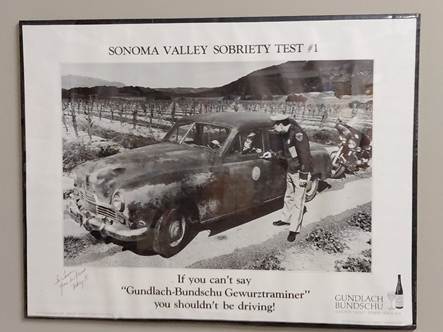
After two posters teaching people how to pronounce our name, we decided it was time to go all in on our humor campaign. For years, Jim Bundschu had been storing an old Kaiser automobile in the barn. It was rusting with fading paint. We dragged the car out to the road leading through our Rhinefarm Vineyard. We got a local, retired CHP officer to put on his uniform and show up on a motorcycle. He even brought a ticket book. In an inspired bit of casting, McCullough, Bundschu and I were able to convince Jim’s mom, Mary Bundschu, to be behind the wheel. Zak captured the shot perfectly.

SONOMA VALLEY SOBRIETY TEST #1

If you can’t say

Gundlach Bundschu Gewürztraminer

you shouldn’t be driving!

The poster was a huge hit. Everybody loved it. Local people clamored for copies. Restaurants and wine shops hung it on their walls. Reporters would see it and show up to write stories about the winery poking fun at the staid fine wine business. We reprinted the poster multiple times. We were off and running.

Over the next ten years, we produced almost two dozen Gundlach Bundschu (and Cutler Cellar) posters. Each one related to something important and true to our winemaking experience. All the featured models were local people happy to help us out. In a time when full color advertising was in vogue, our black and white posters were deemed imaginative and artistic. The release of a new poster was a cause for celebration.

Somehow, in the 30 plus years since the last Gundlach Bundschu poster, the posters and their importance to Wine Country history have been forgotten. For the most part, they were produced and circulated before cell phones and the internet, so they are hard to find. The photos comprising the posters were shot on film, using real cameras and required darkroom development and printing.

Working with McCullough and Bundschu, collaborating with artists like Chuck House, Bob Johnson, and Ron Zak, then bringing ideas to life with gifted printers like Dennis Patterson was thrilling. We respected one another and all contributed to make a product that we were proud to claim our own. Compared to the pressure and sometimes drudgery of making wine, the posters were like playtime for me.

Years ago, I had intended to write about the magic of those glory years st Gundlach Bundschu, but life intruded. Years passed. I found I had forgotten many of the details along with the sequence of events, so I pushed it aside, assuming I would never do it.

One of my Cutler Cellar posters sits on the wall next to my desk. I see it every day. Of the eight people in the photo, only two of us are alive. More than half of the local models appearing in the GB posters, the people contributing ideas, and the salespeople who sold our wine have died or retired. Ben Franklin Press, the company that printed our posters, was sold. It occurred to me that someone needed to tell the story, to honor the people who contributed to this special, historic wine industry moment. I don’t know anyone else who can. That’s why I’m trying to do it now.

Wish me luck.

Meet Chuck House

Russ Koehler owned the first record shop in Sonoma. It was small but had a great selection of music. I was there one day in 1981 looking through bins of albums. I selected two or three promising African artists and brought them to the counter for purchase. Russ laughed as he rang me up. “You should get to know Chuck,” he said, pointing to a tall thin gentleman up on a ladder painting the store logo onto the wall. “You’re the only two customers who ever buy African music in my store.”

I went over and introduced myself to Chuck House. Russ told him that I was the guy who performed his wedding ceremony when he married his wife, Carolyn, and that I was the new winemaker at Gundlach Bundschu. When I asked Chuck if he’d like to take a quick run up to the winery to check it out, he jumped at the chance.

Chuck was great fun. He was enthusiastic, excited by design and he had a unique perspective on art and how it related to a wine bottle. I found out that Chuck was hoping to get into label design for wineries and that he was in fact working for his brother-in-law at Colonna and Farrell in the hope that it would lead to something.

“I don’t know if anything will come of this,” I said, but I know a couple guys who are starting a winery and they need to design a label. Would you like me to introduce you?” At that time, Larry Turley worked as an emergency room doctor in Santa Rosa. My youngest brother Scott, recently out of the navy where he served as a corpsman, worked with Larry as he prepared to enter medical school. Scott introduced us and we became friends. Larry was a tall giant of a man with a loud, raucous laugh and great enthusiasm for life. Chuck realized he had nothing to lose, so I ended up introducing him to Larry Turley and John Williams who were starting up their Frog’s Leap Winery.

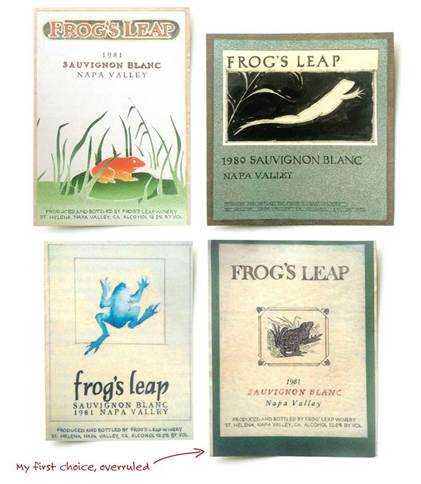
Chuck House met with Larry and John. They told him about their Frog’s Leap project and asked him to come up with some ideas. A few hours before Chuck went to make his presentation, he stopped by my house to show me what he had devised. Chuck House had created several fully formed, hand colored Frog’s Leap labels.

They were incredible, each one better than the last. One looked like something out of Beatrix Potter, another was very realistic, yet another was modern. They went from serious to playful, from rustic to polished. I did not envy the choice Larry and John had to make. By the time things were said and done, Frog’s Leap had their label.

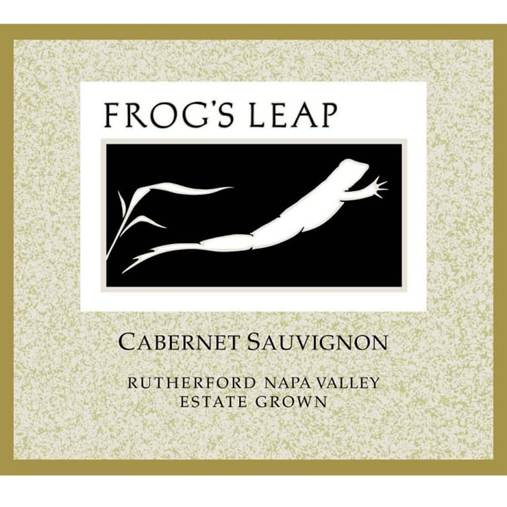
That Frog’s Leap label won a national design award, and Chuck House was on his way to a very successful career as a professional label designer. It also occurred to me that I would try to involve Chuck on any design projects I was working on in the future.

The Salesman

I first met Jim McCullough in 1984. He was imposing, well over six feet tall, and had a deep sonorous voice that rumbled out of his Irish physique with a somber vibration that belied his wonderful sense of humor. Raised in Philadelphia, his family lived across the street from the Catholic Church where his mother cared for the priests. His sister became a nun and Jim even thought of joining a seminary. Alas, his love of ladies and the good life seduced him away from heavenly pursuits. Influenced by his upbringing, Jim McCullough was a twentieth-century man with nineteenth-century sensibilities.

In 1984 I was sent to Los Angeles to work the market for Gundlach Bundschu. Our sales in Southern California were abysmal, and I had been dispatched to find out why. McCullough, I discovered, had left the radio business in 1976 to become the first wine salesman to brave the Rocky Mountains. In those days Aspen, Vail, Telluride, and Steamboat were barely known for their skiing, and certainly no one there knew anything about fine wine. Jim McCullough taught them. He set up tastings, organized staff trainings and regaled them with eloquent histories of famous chateaus. At a time when French First Growths sold for $15 a bottle, his bosses were stunned when this strange, tall Irishman broke one million dollars in annual sales and then continued to do it year after year.

Inevitably McCullough had a falling out with his employers and secured a job as Western Regional Sales Manager for the Spanish wine company Torres. Almost single-handedly he increased their sales to one hundred thousand cases. So stunning were their sales that by 1984 the illustrious Chateau and Estates Wines Company had taken over the brand and McCullough with it. It was not a good match. McCullough was a bit too unpredictable for the staid Chateau and Estates management, so they stuck him in Los Angeles to focus on their one California winery (Gundlach Bundschu) and Torres but refused to let him represent his beloved Bordeaux wines.

After a particularly horrific day of riding around with a typical Los Angeles wine salesman, being insulted by various wine buyers and dealing with interminable traffic jams as we travelled from one account to the next, I could take no more. I called for an end to the day and insisted the wine salesman drop us back at our car. We were in Manhattan Beach. I took McCullough to a liquor store where we bought a bottle of Mt. Veeder Cabernet. I grabbed two plastic cups, and we made our way down to the beach. With the pounding surf in front of us, I opened that bottle of wine and poured it into the cups. We toasted each other and took a sip. That bottle of wine was deader than the Dead Sea.

I insisted McCullough stay at the beach while I went back to the store to exchange the bottle. When I realized the store had no air-conditioning, I figured there might be more problem bottles, so I traded our dead bottle for a bottle of Hornitos tequila and two limes. Armed with fresh cups I returned to the beach where we looked at the gorgeous sunset and drank most of that bottle of tequila. I talked to him about selling wine, distribution, and marketing. His answers showed insight, knowledge, and creativity. I returned to Sonoma and told Jim Bundschu that if he had any sense, he would hire Jim McCullough to be our sales manager.

It came to pass. Jim McCullough was hired as sales manager for Gundlach Bundschu Winery. The year was 1985 and our venerable winery was making some very dynamic wines, but sales were dragging. McCullough took some time to get the lay of the land. He spent time with Jim Bundschu and lots of time with me. He determined that the biggest single problem with the wine was its name: no one could pronounce it. He proposed we break it down to four simple, one-syllable words: Gun-lock-bun-shoe. He had even sketched pictures of a gun, a padlock, a bread bun, and a shoe.

Realizing that there was no advertising budget, McCullough suggested creating a poster that would teach people to pronounce the name. The poster was made at minimal cost. McCullough hit the road and sales started to pick up. Upon his return, McCullough regaled us with details of his trip. Once people learned to say Gundlach Bundschu, they insisted on buying it and teaching others how to say it. He dotted his narrative with historical details and personality assessments as incisive as a Rorschach test. And he was funny, hilariously funny, fall-out-of-your-chair funny.

From that point on and for the next 15 years, Jim McCullough sold every bottle of Gundlach Bundschu wine ever produced. Together, we created dozens of posters that have become eminent artifacts of wine history. He helped create “Fortune Corks” which printed a great quote on every cork. One of the quotes was from McCullough’s grandmother. She often said of her grandson, “Ye were cut out to be a gentleman, but the devil ran away with the pattern.” When the Bundschu clan hijacked the Napa Wine Train, it was McCullough who insisted we wear black velvet capes and masks.

As time went on, and the winery’s sales skyrocketed, McCullough and I convinced Bundschu that we needed to acknowledge and thank the friends we had made on the road. We created the Sonoma Valley Wine Patrol and highlighted each year with a four-day party that took 80 invited celebrants into a region in ways no tourist could duplicate. McCullough sought out historic buildings in downtown areas and would somehow arrange for elaborate wine dinners to be held in their lobbies. He could find fiddle champions in Missouri and entice them to perform. He would lead tours of mansions, farmer’s markets, and tiny neighborhood parks known only to locals… and Jim McCullough. The wine patrollers would eat nothing but great food, but they could find themselves at a dive full of personality just as easily as an elegant restaurant.

McCullough certainly was successful. Without him, there might not be a Gundlach Bundschu Winery, and we certainly would not have gained the reputation as the legendary “Joy Boys” accorded us by history. McCullough was a complicated man. Salesmen would cringe when he came to town. They knew they would sell a lot of wine, but they also knew a couple of accounts would throw them out based on some of McCullough’s insensitive comments. He was one of the greatest speakers on wine I have ever heard, but he could kill a happy crowd in an instant with a morose comment.

McCullough was gone from Gundlach Bundschu by 2000. He worked in New Mexico, then Oregon before returning to Sonoma. He worked in tasting rooms where he sold tons of wine but eventually was let go for various slights. A twentieth-century man with nineteenth-century sensibilities doesn’t do well in the twenty-first century wine business. Eventually, he returned to his native Philadelphia, ostensibly to live out the rest of his life in the bosom of his large family. His health was not good, and he spent the last few years of his life receiving dialysis treatments three times a week and enduring repeated hospital visits. He passed in 2019.

With Jim McCullough you got the good, the bad and the ugly. He was one of the seminal characters in California wine history, but he is largely unknown and forgotten. I loved him like a brother. Before he died, had you turned up in Philadelphia, he would have found you the best cheesesteak, the finest cheap seat at the Philharmonic, and given you an historical perspective as clear as the liberty bell. Of course, he’d probably have pissed somebody off as well.

Forgotten History

Tales from the Reawakened Wine Patrol

by Lance Cutler

Sometimes life is all about timing. Being in the right place at the right time makes all the difference. I didn’t plan on being there. I just knew I had to get out of Los Angeles. I had to escape with my family to some other place. I yearned for a more rural existence, one far removed from the despair of inner-city Los Angeles and the hassles with police and the intense, passionate pleadings of political true believers.

So, in 1977 I found myself in Sonoma, California, a small rural community steeped in history and populated primarily by elderly retirees. The center of town circled around a lovely park with mature trees and a duck pond. The northern-most mission of the Spanish conquest anchored one corner, the hardware store another. In the middle of First Street East, locals would shop at the market taking time to sit at the lunch counter for a cup of coffee and gossip.

A poor farming town in a gorgeous setting, Sonoma survived by growing apples, pears, prunes, and some wine grapes. Restaurants were family style and inexpensive. If the food was not exciting, at least it was plentiful. The bars did big business, mostly on-the-rocks drinks, martinis and Manhattans.

I landed a job as director of a small, private elementary school. The pay was $600 per month, nine months a year, with free tuition for my daughter. We lived in an 864-square foot house on two acres of land, which we shared with our landlords, the Boninos. Our rent was $165 per month; $150 if we kept the leaves raked.

In the summer of 1978, with no salary coming in from the school, I signed on for a job in the Gundlach Bundschu tasting room. A small family winery dating back to 1858, Gundlach Bundschu had been revived by Jim Bundschu and his two brothers-in-law. I worked the tasting room Saturday and Sunday from 12 to 4. Often, no one would show up for hours at a time. I earned $3.00 per hour. The Merlot and Zinfandel sold for $5.00 per bottle; the Cabernet Sauvignon was $5.50.

I returned to the school in September, working from 9 to 3 and then working at the winery from 3:30 until midnight to help with harvest. In February of 1979, the Bundschus asked me to work full-time at the winery. They offered $3.50 per hour. I accepted the offer.

I worked at Gundlach Bundschu for 18 years. I became winemaker, then general manager and won the Winemaker of the Year Award in 1983. Along with Jim Bundschu and Jim McCullough, I helped turn Gundlach Bundschu Winery into one of the most respected and revered wineries in all of California.  We made wonderful wines which sold at very fair prices.

We honored the Hispanic contribution to winemaking and grape growing. We started the first humorous marketing program in the fine wine business. We invented the Sonoma Valley Wine Patrol. We hijacked the Napa Wine Train, kidnapped Richard Branson, and trained many of the best winemakers of California. We rode the tidal wave of the fine wine boom as it grew from a simple, local business to become one of California’s most important industries, accounting for more than $84.5 billion in annual economic output.

The three of us, working together, created a magical kingdom that welcomed anyone willing to work hard and laugh at themselves. Hundreds and eventually thousands of people discovered this special place and signed on to be a part of it. There was no other winery like it. There likely will never be another.

This is the story of how that magical place started, developed, and eventually withered away. It is a story filled with creativity, a brutal work schedule and laughter, lots of laughter. It is also a story of death and murder. In the end, this is the story of the California wine business.

For those of us in the wine business in those days, life was hard, but it was fun, and no place was more fun than Gundlach Bundschu. It was a magical place spreading joy and wonder everywhere.

Is it all true? I can’t say for sure. Memory twists the truth, and what’s true for one person is not always true for another, but I was there. These are things that I did. This is how I remember it.

People say you must record the history. You must pass on the truth. We cannot leave the story to private equity firms, billionaire serial buyers and large wine conglomerates like E.J. Gallo and Constellation.

I was in the right place at the right time, and this is my story, so I’m going to try to tell it.

It Could Work by Jake Lorenzo

Last week Jake Lorenzo went to Napa to pick up some glass for my upcoming bottling of Guerrilla Vino. Coming home, it was 2:00 PM, with the lunch rush winding down, so I stopped into a restaurant to say hello to a longtime Chef/owner friend and maybe have one of his legendary meatball appetizers. Chef sat at a table sampling some wine with a salesman and the director of his wine program. Seeing me, he leapt from his chair, gave me a hug and insisted I join them. The salesman poured a Cabernet Sauvignon from Alexander Valley that was lush, complex, full of flavor, and carried by great acidity with a soft tannic finish. We all nodded our heads, “Delicious.”

The salesman said, “And the winery is blowing this out for just $10 a bottle, trying to land by-the-glass placements.”   Chef talked to his young wine director, Bobby, asking what they would charge as a by-the-glass price. With a straight face Bobby replied, “I think it would do well at $22 a glass.”

Jake Lorenzo went off like a plugged fermentation lock exploding from a barrel. I hurtled across the table, knocked Bobby backward in his chair and had my hands squeezing his throat as his face turned red. Fortunately, Chef and two waiters pulled me off him before I had caused any serious damage. Bobby gasped to catch his breath, terror in his eyes as he looked at me.

I admit; it was not this detective’s proudest moment, but for more than 30 years I have been railing against restaurants that used outrageous wine and beverage markups as their primary profit centers. Depending on the size of their glass pour, Bobby was proposing marking up this bottle of wine 10 to 12 times cost. This detective bled for the winery, forced to sell their wine at a major loss, probably in need of some cash flow and to move some products off their inventory. Instead of passing along the savings to their clientele, thus encouraging more consumption (after all a depletion is a depletion) Bobby was gouging the winery and his customers assuming $22 a glass for wonderful Cabernet Sauvignon would seem like a deal.

Jake Lorenzo has always had a hard time with restaurant wine markups. The old standard wine list markup of three times cost caused my blood pressure to rise. When they decided the price of a single glass of wine should equal the cost of the bottle, my fists would clench involuntarily. As I watched glass pours shrink from six ounces to five ounces and now sometimes just four ounces, I needed Jakelyn’s mother or Chuy or some other trusted friend to remind me to breathe slowly until my heartbeat returned to normal.

Surely, I thought people weren’t going to put up with these ridiculous mark ups. Years ago, when restaurant wines started at $30 per bottle, I assumed there would be some backlash. No? When the bottom of the list started at $40 customers would make it known that the price is too high. Still, no? Well, who the hell was going to drink wine with their pizza when the cheapest bottle went for $50? I had counted on the dining public coming to its senses and demanding that restaurants lower their markups or at least provide reasonable alternatives for those of us who love a good meal accompanied by a thrilling bottle. It didn’t happen, and restaurants assumed they could continue to raise prices at will.  At some point a private eye needs to give up. When wine lists climbed to a $60 per bottle starting point, this detective stopped going to restaurants.

Since I rarely go to restaurants now, I didn’t notice that people had finally hit the wall on wine pricing. Several recent surveys show a 15 to 30 percent drop in restaurant wine sales. That’s not all, tourists no longer flock to wineries to taste their wares, wine club members are fleeing like beachgoers in the face of a tsunami. Wineries are laying off staff, closing production facilities, and ripping out vineyards. Local wine is just too damn expensive for many of us, but wine gives us pleasure and is part of our daily ritual, so we scour store shelves for reasonably priced wonders from other parts of the world. Instead of going to a restaurant, we cook a nice meal at home with friends, share a couple bottles of wine and save a fortune.

Let’s get something straight, right off the bat. Jake Lorenzo, private eye, loves a delicious meal cooked by a talented chef, especially when accompanied by a couple bottles of fine wine. Jakelyn’s mom and I aren’t fashion plates, we don’t gamble, nor do we use drugs, so our discretionary spending is focused on travel, food, and wine. A three hour lunch is one of the glories of life, and for decades we have been dedicated to discovering the right chefs, sampling their inventive cuisine, and enjoying those meals while sipping tasty wines.

After a delicious meal, it is customary for us to invite chefs to our table to share a glass of wine. If they are congenial and show a sense of humor, we invite them over to the house, offering to cook for them. Usually, by the time we give them a second invitation, they have checked around with other chefs who have visited us and are willing to come over. For years, chefs have joined us at table, scoured my wine cellar, and wandered through Jakelyn’s mother’s garden

Sadly, it seems this time has passed. Jakelyn’s mother and I rarely go out to restaurants to eat. When a simple meal for the two of us with a single bottle of wine adds up to $200 to $300, we cannot justify the devastating hit on our monthly budget that a couple meals out will inflict. We still want to go to your restaurant, eat your food and support your business, but you need to work with us to get us to come back.

I propose restaurants start locally. Forget about trying to attract the rich and famous and work on getting your neighbors to walk through the door. Have at least one night a week where you waive corkage. This would allow us to sample your food and drink decent wine but still have enough money to pay the electric bill. Try one night a week where all the wines on your list are half price. Believe it or not, wine lovers appreciate good wine with delicious food. Give them the opportunity to try wines a bit beyond their reach. You’ll still make plenty of profit, and you’ll have customers returning regularly. Actively search out inexpensive wines that you love and add them to your list at reasonable markups so your customers can enjoy them as well. When you get deals on wine from desperate wineries, share some of the savings. If your cost is $10 per bottle, charge $30 on the list and $8 per glass. You’ll still make three times cost, but you’ll make your customers happy.

As much as you want to push strange tasting natural wine, or rare, exotic varietals, drop a few from your list to honor local, historic pioneers still pursuing the dream. Were it not for their struggles and success you probably wouldn’t even be here, and after corporate entities had their way with the California wine business, there aren’t many family wineries left.  Every Napa restaurant should be selling Storybook Mountain Zinfandel, Lang and Reed Cab Franc and something from Frog’s Leap. Shouldn’t all Sonoma County restaurants serve Pellegrini-Olivet Lane and maybe Rochioli? Doesn’t Tobin James belong on every list in Paso Robles along with a Dusi Zinfandel? Adam Tolmach has been making great wine from the very beginning. His wines deserve a place on any restaurant wine list from Los Angeles to Santa Barbara. Learn your history. Honor the pioneers. They are not getting any younger.

Happy hour is your friend. A few selected dishes along with some interesting wine and beer selections will encourage people to try your food. Bring back winemaker dinners that are bargain priced instead of $150 and up. Wineries are desperate to deplete mounting inventory. They’ll give you a deal to feature their wine with your food.

It could work. What have we got to lose? Times are tough. We’ve got to try something. Restaurants and wineries should be partners in providing a great experience for people who love food and wine. We should work together for a common goal.

It could work.

On the Passing of Dreams by Jake Lorenzo

From the Library, July 2008        

In the late 1960s, the first California varietal wines to grace this detective’s palate came from the new Robert Mondavi Winery in Oakville. I had no idea where Oakville was since I was often mired in my daily commute from Santa Monica to East Los Angeles where I was teaching Hispanic kids to read in English. Teaching got me into drinking, and drinking led me to the wine business.

By 1977, Jake Lorenzo had moved, with his family in tow, to California Wine Country. It was certainly one of the best life decisions I have ever made. In my 30 years’ working in the wine business, I never passed an evening with Robert Mondavi. I shook his hand a couple of times, had a couple of superficial conversations and in the very early days spent many a delightful evening listening to the superb music at his summer concerts.

He was a big man, tall with a booming voice and an enthusiasm that matched, but more than anything Mondavi was a salesman and a dreamer. His dream was to sell a pile of California wine, and his pitch was to take on the established, great wines of the world and challenge them “mano a mano” with his upstart varietals.

Robert Mondavi would march into the greatest restaurants in the world. He would plunk his bottles down on the table, order some of the famous First Growths off the list and insist that his guests taste the wines side by side, knowing that just having his bottles on the same table as the great wines of France lent them an air of legitimacy. He would smile his snake-oil grin and concede, “We’re not there yet, but some day soon our California wines will be as good as theirs.” Then he would pay the bill, tip large and move to the next grand restaurant to repeat the show.

Mondavi was our ambassador to the wine world. He pushed his winemakers to compete with the finest wines of the world because he knew that was where the money was. He was imaginative, insistent, clever and decidedly American in his brash, trash-talking challenge of the established icons of wine. His surprising legacy is that he not only convinced the French and Europeans that California could compete with them, he convinced us that our wine was as good as theirs.

Every California winemaker will be forever indebted to Robert Mondavi because he took the high road in trying to sell his upstart wines, and that high road was to dedicate his efforts to quality.

Mondavi’s passing reminds me of others who have left us, others far less famous but not necessarily less important. Next year will be the 20th anniversary of Tracy Toovey’s death. Tracy exemplified the enthusiasm, dedication and sense of wonder that comprised the wine industry in the ’70s and ’80s. Tracy worked as the cellar master at Grand Cru Winery. The hours were long, and the work was very difficult. Pay was not much higher than minimum wage.

Tracy was gentle and kind, but he was fiercely determined to make fine wine and he took immense pride when his attempts succeeded. Tracy, like most of us in those days, lived and breathed winemaking. We hadn’t come from families with wine history, and we were eager to make up for lost time. We all held wine tastings, traded wine and shared any wines we could find from other countries. A chance to taste some of the great wines from France or Italy would see a whole group of us piled into a car going to San Francisco, even if it meant having to work at the winery over the weekend to make up for lost time.

When Tracy got married, the ceremony was held at Grand Cru Winery. Lance Cutler performed the nuptials. Mark Stupich, Jeff McBride and Ray Kaufman all sang in the choir. The guests made up a “who’s who” of working winemakers and cellar rats, and the sheer amount of wine consumed would have made Robert Mondavi confident about the success of California varietals in the future.

Over the next few years Tracy and his wife had two kids and bought a tiny house in Glen Ellen. Most evenings and weekends he would work on the house, adding on bedrooms or a dining room or installing new handmade kitchen cabinets. He planted some vines in his backyard and made wine from those grapes. Tracy worked at a job he loved, passed his time with a family that he worshipped, and spent time exploring hobbies and interests that intrigued him.

In 1989 Tracy Toovey, like the rest of us, had been in the wine business for more than 10 years. We had seen demand for our wines grow and grow. We had been through one ill-financed expansion after another. We had learned our lessons about cold stability, heat stability, malolactic fermentations and Brettanomyces infection. We reveled in harvest, groaned on the bottling lines and enthusiastically shared each new bottling with our contemporaries as soon as they were bottled. Life was good.

Then, for Tracy Toovey, life was over. Tracy was murdered on April 14, 1989 at the winery by Ruben Salcido who was reportedly drunk and coked-up. Salcido ended up killing seven people including his wife and two of his children.

For Grand Cru Winery, the aftermath was not their finest hour. They refused to even pay for health insurance for the surviving Toovey family. Cellar rats, vineyard workers and other winery workers in Sonoma Valley stepped into the breach. We signed petitions donating one hour’s pay each year so that Tracy’s family would have continued health care.

The harvest of 1989 was one of the rainiest on record. It was as if the sorrow over Tracy’s death had opened up the tear ducts in the sky, and it couldn’t stop crying. The mud was so deep in the vineyards that it would suck the boots right off your feet. Whole blocks of Chardonnay grapes rotted to nothing on the vines.

In 1989 most of us in the wine business were young, strong, passionate and in love with our jobs and our lives. To lose Tracy–someone our own age, someone with a family like ours, someone who shared our aspirations–was a devastating blow. It made us think. It made me think about life, family and what is truly important.

Robert Mondavi had a dream, and he will be remembered in history books for achieving that dream and creating the California wine industry as we know it. Jake Lorenzo says that Mondavi never would have achieved that dream were it not for the likes of Tracy Toovey. It was the dedication and enthusiasm that hundreds of workers like Tracy brought to the wine industry that gave it the extraordinary spirit that lifted it into the 21st century.

Tracy Toovey had a dream. He never got to see it through. But he changed Jake Lorenzo’s life, and without you knowing it, he changed yours too. Robert Mondavi can have the history books. Tracy has this detective’s heart. I hope you are lucky enough to have memories of him tucked into yours as well.  wbm

Life Goes On by Jake Lorenzo

Wine Business Monthly has decided its readers no longer need the insights provided by an aging winemaker/detective. They clearly gave little thought to the financial needs of that same aging writer, but that is the way of the world. It’s been two months since this detective has written anything, but the time has come to say something.

So, Jake Lorenzo sits at the keyboard gazing through the window at our glorious backyard garden, which after weeks of backbreaking work is 90 percent cleared of winter weeds. Hummingbirds flit about the bright red/yellow bulb flowers that dangle like Christmas ornaments on the maple bush. The Green Goddess lilies are in full bloom, orange poppies glow in the sunlight and purple lilies have started their ascension. Spring is upon us. Life goes on.

Today is St. Patrick’s Day and I spent the morning making a SO2 addition as I racked three carboys of Pinot Noir Nouveau. I topped my barrels of 2025 Pinot Noir and Syrah, and I transferred a couple cases of Guerrilla Vino Pinot Noir from the winery to my house cellar. I went to the garden, harvested both lettuce and arugula, washed and cleaned them, and put them into the refrigerator. I walked down to Ye Olde Public House and had a solitary Guiness enjoying the idle conversation of unfamiliar bar mates and bartenders. Life goes on.

It’s not like this detective has been idle during this period of gainful unemployment. The days of madness that encompassed Christmas and New Years were loaded with friends, fine meals, and good times. We had eight for our traditional Christmas dinner of Prime Rib with Yorkshire pudding, spread out company through the week and celebrated New Year’s Eve with 14 in attendance for our traditional Dungeness Crab Feed (cooked like Cajun Crawfish.)

Daily weeding in January was broken up with chores. I had to put a new roof on the shed because it leaked when it rained. That revealed some rot, so a couple of beams got replaced along with two side panels. I pressure-washed the whole shed, primed it and then repainted it. It’s looking great for the upcoming summer.

By then it was time for Jake Lorenzo’s birthday, so we escaped the Northern California rains for two weeks of sunshine with friends in their Cabo San Lucas home overlooking the Pacific Ocean. We watched whales frolic in the Pacific, leaping from the water to splash back into the ocean again and again. Fleets of tourist-filled boats chased them until the whales grew weary and dove deep to be left alone. We weren’t as close, but still had a magnificent view, leaning on the edge of the pool with palomas in hand.

Each night, we’d wander down to town for a great meal, visiting old favorites like Farol 16, JM Steakhouse, or Invita Bistro. We did our mandatory crawl to Vas Que Vuelas for tlayudas followed by Tacos Ramiros and his incredible suadero. We were thrilled to find Mesa de Luna, a brand new favorite to add to our regular rotation. Guacamole y Pork Belly Chicharron, Aguachile de Costillas, Roasted Beet Carpaccio, and incredible Grilled Octopus all served with homemade tortillas, bread, and desserts. Some things don’t change and two weeks in Mexico is always good for the soul, even when the government unleashes its soldiers on the cartels inciting a round of setting vehicles on fire to disrupt traffic patterns.

We spent late nights deep in discussions, and since our hosts and the other guests were in the wine business we often pondered the downturn in the wine business. We made it a rule to never talk about the wine business while drinking wine, So Jake Lorenzo offered his theories while imbibing mezcal or tequila. Jakelyn’s mom stuck to a bottle of McCallan 12 Scotch, which she timed out perfectly to finish on our last night.

Typical causes for wines decline came up in our conversations. Wine was too expensive as were the tasting fees. Boomers were drinking up their cellars instead of replenishing them. Young people weren’t drinking. Tariffs were increasing costs. There were too many vineyards, grapes, and wineries. All good plausible causes for wine’s downturn, but this detective inserted something else. The population is too concerned with its health.

Granted, this is not original to Jake Lorenzo. I got most of my information from Dr. Iggy Calamari, inventor of the wine powered pacemaker. Dr. Calamari cited studies that show being fit is today’s biggest status symbol. One third of Americans said they’d like to live forever. They get real time health tracking from wearables that can run blood results on Chat GPT. Consumers are focused on their health, and they are being told that wine is unhealthy.

It’s not enough for people to feel good, they want to look good too. These days looking good is being skinny. One out of every eight adults, 15.5 million people in the United States, are using or have used GLP-1 medications like Ozempic or Wegovy to help control their weight. Dr. Calamari warns that GLP-1 medications target all pleasure centers in the brain. They don’t just reduce your desire to eat, they can reduce your desire to gamble, go out to events, or drink. If you are using GLP-1s, then you are likely drinking less than before. The desire to drink occurs less often and when you drink you drink less.

Whatever you think of President Trump, his policies have had a devastating effect on tourism in the United States. This past year, we welcomed 11 million fewer tourists than the year before. The U.S. was the world’s only major travel destination with a decline in international tourists. Take 15.5 million people on GLP-1 drugs and remove an additional 11 million tourists looking for a good time from the wine drinking equation, and you’ve got a good start for a downturn in consumption.

This detective thinks this focus on personal health is unhealthy. I work in my garden to grow my own organic vegetables, so much of what I eat is healthy I stretch my muscles when I reach for a bottle of wine on the top shelf of my wine cellar or when I crouch down to select bottles from cases on the ground.  I get enough exercise walking to my local wine shop to buy wine.

After years of experience, I am convinced that drinking wine relieves stress, that having a satisfying meal with friends contributes to our well-being, and that spending time with friends is essential for living a rewarding life. I’m glad people want to be healthy, but we must bring moderation to bear on this emphasis on personal health. The true benefit of being healthy is to enjoy life. Wine helps us enjoy life. Life goes on. Pull a cork today, it’s the best you can do for yourself.