Ray and Eduardo, along with dozens of their friends, worked on our mural for six months. Slowly, the whitewash got covered, and the drips and splatters of the early color code work evolved into recognizable figures and scenes. Bit by bit the outlines completely disappeared, replaced by dramatic, lush color.
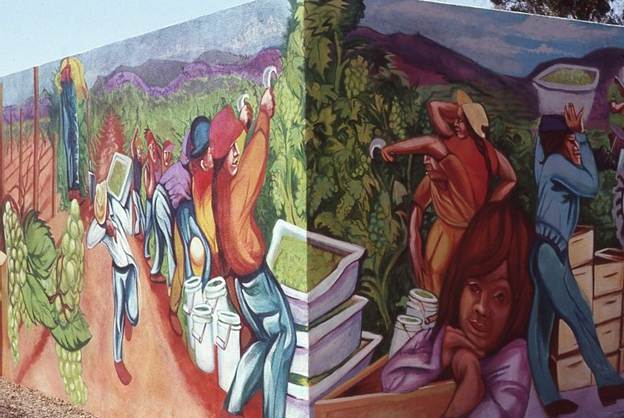
Watching the artists work was fascinating, and the technique was stunning. They did not paint items and then touch them up with other colors for accent detail. Instead, they would take a single element, let’s say a character’s pants, and paint the entire area a dark blue. The next week they’d return with a lighter shade of blue and once again cover the entire area, but leaving a few areas of the original dark blue peeking through. A third pass with a grayish blue covering the entire area but leaving the dark blue and some of the lighter shade of blue. In this way, virtually every square inch of the mural received four to six coats of paint. Layer upon layer of paint created a depth of color and a passionate feeling of movement and vibrancy. It was magical.
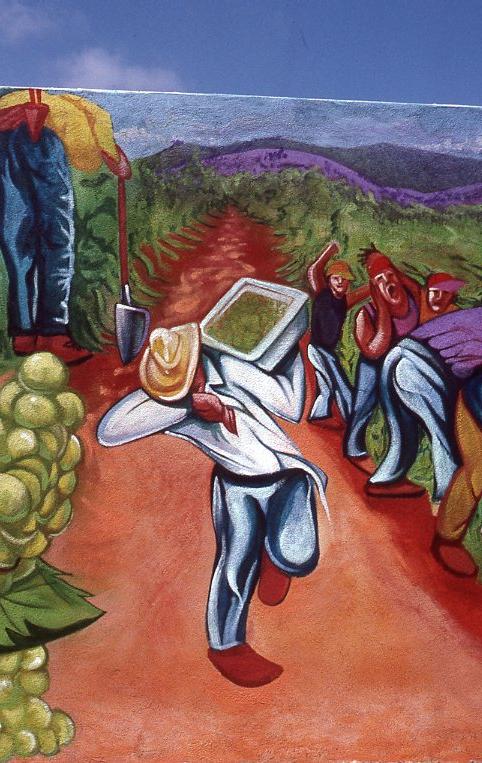
A composition for the mural combining three original slides from the slideshow. In the upper left corner, a worker in the vineyard with a shovel. Down the row a picker carrying a lug box of grapes. On the right, pickers working a row with others shouting for more lug boxes.
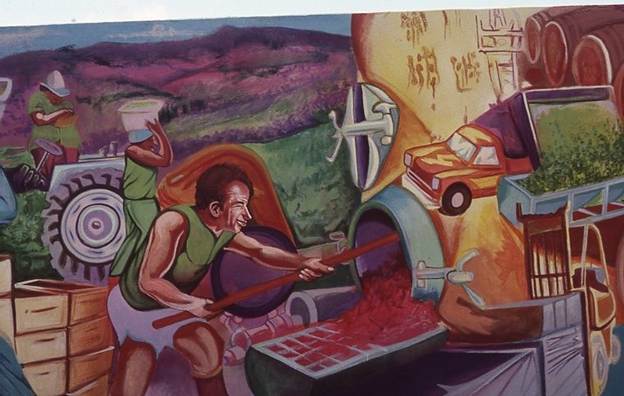
Another amazing montage from the original slide show. A stack of lug boxes, and a picker carrying a box of grapes while it is tallied by the man with the hat. To the center right, a truck dumps grapes into the hopper of our crusher with a forklift moving bins in the lower right corner. At the center is a figure racking fermented grapes into the minestrine pump going to the press. Originally, this was to be a woman, but Ray and Eduardo insisted that I appear somewhere in the mural, so they put me here.
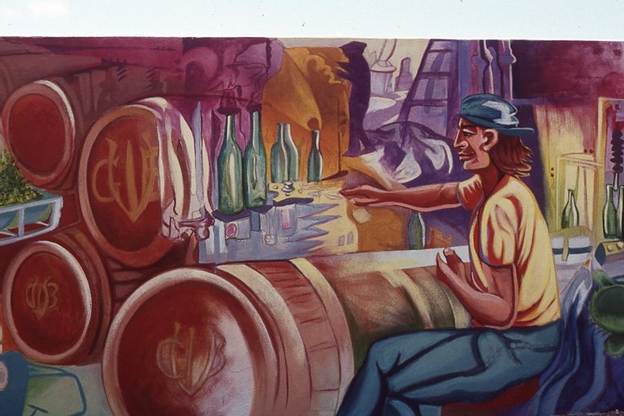
Another montage from the slide show showing wine aging in barrels and working on the bottling line.
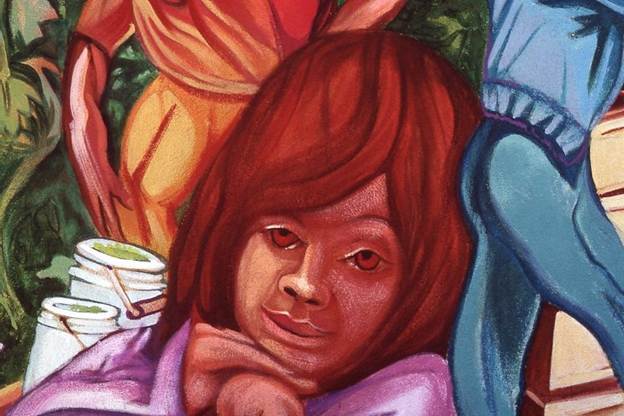
A close up of a child.
For everything we did at Gundlach Bundschu, I tried to include family. On weekends, pickers were encouraged to bring their kids. We’d let them drive the tractors.
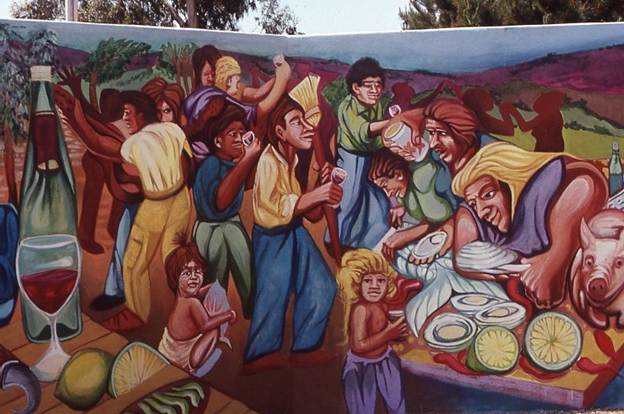
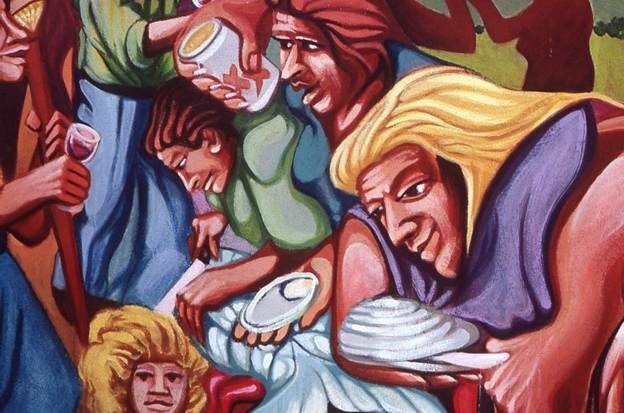
We took every opportunity to have a party. The last load of white grapes into the winery set off the oyster feed. We’d have music and the guests would dance. Since, in those days, there were always more men than women, we employed a Mexican tradition of having a man dance with a broom. The man put on lots of moves with the broom getting cheers and jeers from the crowd. After a bit, he’d pass the broom to someone dancing with a partner and cut in, while the new broom dancer became the focus of attention.
The end of harvest featured a whole pig carnitas roast. We’d often host simple barbecues where we served the incredible sausages from the Sonoma Sausage Factory. This is all depicted on the mural. We even have Gundlach and Bundschu cooking the sausages at the giant Weber grill.
Ray and Eduardo centered the mural with something uniquely symbolic. In front of a full moon (because Sonoma is The Valley of the Moon,) is a Michelangelo reference, but this time it is a grape grower and winemaker touching fingers. Because the mural is honoring the Hispanic contribution to winemaking, agave plants are in the foreground.
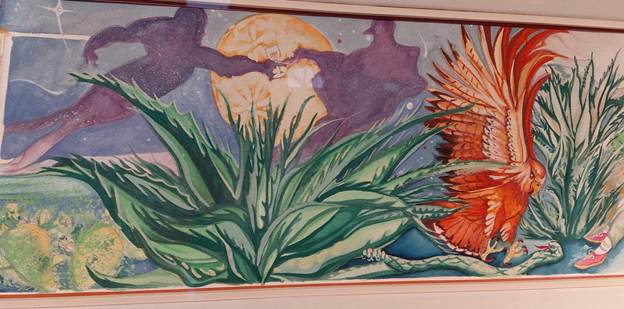
The Mexican flag depicts an eagle with a snake in its talons. According to Aztec mythology, the eagle represents the sun god Huitzilopochtli. The snake represents the earth goddess Coatlicue. Their presence on the Mexican flag symbolizes the union of heaven and earth, and the continuity between the ancient indigenous cultures and the modern nation of Mexico.
Legend also has it that the Aztecs were guided by a prophecy to settle in a place where they found an eagle perched on a cactus, devouring a serpent. They found the eagle with the snake and settled where Mexico City now stands. Referencing ancient Aztec beliefs and legends was amazing enough, but Ray and Eduardo elevated the reference by changing out the eagle and serpent for a redtail hawk and a rattlesnake because they were indigenous to Sonoma.
The mural was finished. Eight feet high and 120 feet long; it was massive. It depicted the entire winemaking process from planting vines, to crushing grapes, aging, and bottling wine. It emphasized the role and contributions made by Hispanic people to the wine industry, and it showed many instances of the events that made winemaking at Gundlach Bundschu Winery unique.
There was only one thing left to do.

Wonderful!